Can ship immediately
Due to market price fluctuations,if you need to purchase or consult the price.You can contact us or emial to us: brenda@hongda-ic.com
1. Describe
The AD5760BCPZ is a true 16-bit, unbuffered voltage output digital-to-analog converter (DAC) that operates from bipolar supplies up to 33 V. The AD5760 accepts a positive reference input range of 5 V to VDD − 2.5 V and a negative reference input reference input range of VSS + 2.5 V to 0 V. The AD5760 provides a relative accuracy specification of ±0.5 LSB maximum range and guarantees monotonic operation with a ±0.5 LSB differential nonlinearity (DNL) maximum range specification. The device features a general purpose 3-wire serial interface with clock frequencies up to 35 MHz and is compatible with standard Serial Peripheral Interface (SPI), QSPI™, MICROWIRE™ and DSP interface standards. The device includes a power-on reset circuit that ensures that the DAC output powers up to 0 V at a known output impedance state and remains there until a valid write to the device is made. The device provides an output clamp function that places the output into a defined load state.
2. Feature
1. True 16-bit voltage output DAC, ±0.5 LSB INL
2. 8 nV/√Hz output noise spectral density
3. 0.00625 LSB long-term linearity error stability
4. ±0.018 ppm/°C gain error temperature coefficient
5. 2.5 µs output voltage settling time
6. 3.5 nV-sec mid-range glitch pulse
7. Integrated precision reference buffer
8. Operating temperature range: −40°C to +125°C
9. 4 mm × 5 mm LFCSP package
10. Wide supply range up to ±16.5 V
11. 35 MHz Schmitt trigger digital interface
12. 1.8V compatible digital interface
3. Application
1. Medical equipment
2. Test and Measurement
3. Industrial Control
4. Scientific and aerospace instrumentation
5. Data acquisition system
6. Digital Gain and Offset Adjustment
7. Power Control
4. Product Highlights
1. True 16-bit precision.
2. Wide supply range up to ±16.5 V.
3. -40°C to +125°C operating temperature range.
4. Low 8 nV/√Hz noise.
5. Low ±0.018 ppm/°C gain error temperature coefficient.
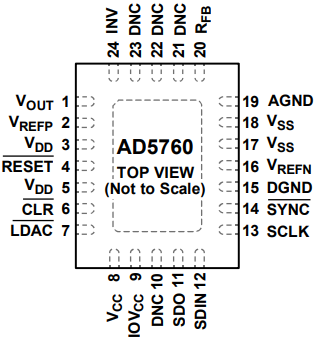
5. Pin configuration
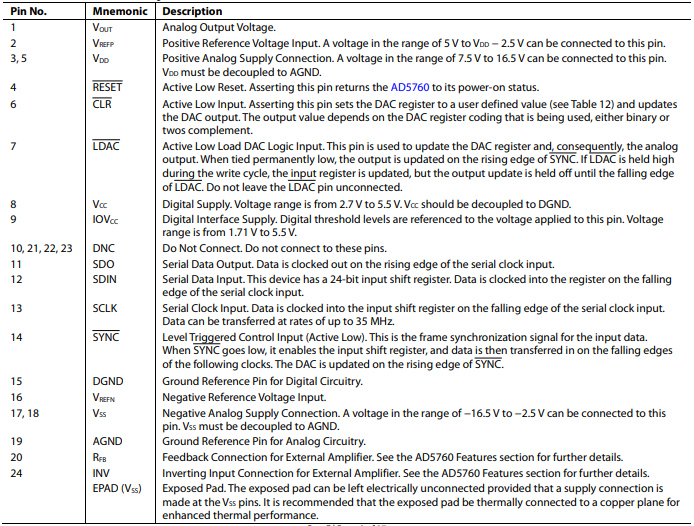
6. Pin Description