
Can ship immediately
Due to market price fluctuations,if you need to purchase or consult the price.You can contact us or emial to us: brenda@hongda-ic.com
1. DESCRIPTION
The ADS7843E/2K5 is a 12-bit sampling Analog-to-Digital Converter (ADC) with a synchronous serial interface and low onresistance switches for driving touch screens. Typical power dissipation is 750µW at a 125kHz throughput rate and a +2.7V supply. The reference voltage (VREF) can be varied between 1V and +VCC, providing a corresponding input voltage range of 0V to VREF. The device includes a shutdown mode which reduces typical power dissipation to under 0.5µW. The ADS7843 is specified down to 2.7V operation. Low power, high speed, and onboard switches make the ADS7843 ideal for battery-operated systems such as personal digital assistants with resistive touch screens and other portable equipment. The ADS7843 is available in an SSOP-16 package and is specified over the –40°C to +85°C temperature range.
2. FEATURES
1. 4-WIRE TOUCH SCREEN INTERFACE
2. RATIOMETRIC CONVERSION
3. SINGLE SUPPLY: 2.7V to 5V
4. UP TO 125kHz CONVERSION RATE
5. SERIAL INTERFACE
6. PROGRAMMABLE 8- OR 12-BIT RESOLUTION
7. 2 AUXILIARY ANALOG INPUTS
8. FULL POWER-DOWN CONTROL
3. APPLICATIONS
1. PERSONAL DIGITAL ASSISTANTS
2. PORTABLE INSTRUMENTS
3. POINT-OF-SALES TERMINALS
4. PAGERS
5. TOUCH SCREEN MONITORS
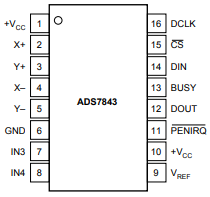
4. PIN CONFIGURATION
5. PIN DESCRIPTION
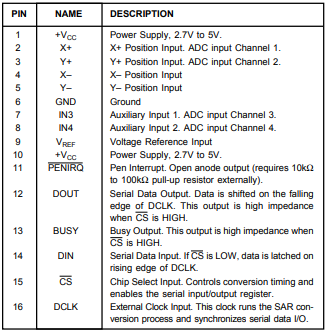
6. Principle of Operation
ADS7843 is a classic successive approximation register (SAR) ADC. The architecture is based on capacitance Redistribution essentially includes sample and hold functions. The converter is manufactured on 0.6µs CMOS. The device requires an external reference and an external clock. It uses a single power supply ranging from 2.7V to 5.25V. The external reference voltage can be any voltage between 1V and +VCC. The value of the reference voltage directly sets the range of the input converter. Average reference input current Depends on the conversion rate of ADS7843. The analog input of the converter is provided through a four-channel multiplexer. Unique configuration of low on-resistance switch allows unselected ADC input channels Provide power and accompanying pins to provide grounding to external devices. By keeping the differential input to The converter and differential reference architecture can eliminate the on-resistance error of the switch.
7. Digital interface
The typical operation interface of ADS7843 digital circuit. This figure assumes that the digital source signal is a basic serial interface to a microcontroller or digital signal processor. Each communication between the processor and the converter consists of eight clock cycles. One or three serial ports can complete the complete conversion communication, and there are a total of 24 clock cycles input on DCLK. The first eight clock cycles are used to provide the control byte through the DIN pin. When the converter has enough information about the following conversion to set up the input multiplexer, switch and reference the input appropriately, the converter enters the acquisition mode, and if necessary, the internal switch is turned on. After three more clock cycles, the control byte is complete and the converter enters the conversion mode. At this time, the input sample and hold enters the hold mode, and the internal switch may be closed. This next 12th clock cycle completes the actual A/D conversion. If the conversion is a ratio conversion (SER/DFR LOW), the switch is open during the internal conversion.
8. Control byte
ADS7843 will ignore the input on the DIN pin until the start bit is detected. The next three bits (A2-A0) select the active input channel or the channel of the input multiplexer. The MODE bit determines each conversion, 12 bits (low) or 8 bits (high). The SER/DFR bit controls the reference mode: single-ended (HIGH) or differential (LOW). (Differential mode is also called ratio conversion mode.) In single-ended mode, the reference voltage of the converter is always the difference between the VREF and GND pins. In the differential mode, the reference voltage is the currently enabled switch. The last two digits (PD1-PD0) select the power-down mode shown in Table V. If both inputs are high, the device is always powered on. If both inputs are low, the device enters between power-down mode transitions. When a new conversion starts, the device will immediately resume normal operation-no delay is needed to allow the device to power up and the first conversion will be effective. There are two power-down modes: one is to disable PENIRQ, the other is to enable PENIRQ.
9. Power consumption
ADS7843 has two main power modes: full power and automatic power-off (PD1-PD0 = 00B). When running at full speed and 16 clocks per conversion, the ADS7843 spends most of the time acquiring or converting. The time for automatic power-off is very small, assuming that the mode is active. Therefore, the difference between full power mode and automatic power off is negligible. If the conversion rate of DCLK input is reduced by simply lowering the frequency, the two modes remain roughly equal. However, if the DCLK frequency remains at the maximum conversion rate during this period, but the conversion frequency is lower, The difference between the two models is huge. It's time in power down mode. Another important consideration for power consumption is the reference mode of the converter. In single-ended reference mode, the internal switch of the converter is only turned on when the analog input voltage is obtained. Therefore, external devices, such as resistive touch screens, are only powered on during the acquisition period. In the differential reference mode, the external device must be powered during the entire acquisition and conversion period. If the conversion rate is high, this may significantly increase power consumption.

