Can ship immediately
Due to market price fluctuations,if you need to purchase or consult the price.You can contact us or emial to us: brenda@hongda-ic.com
1. Description
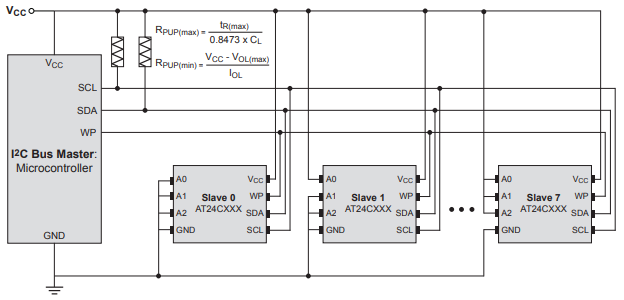
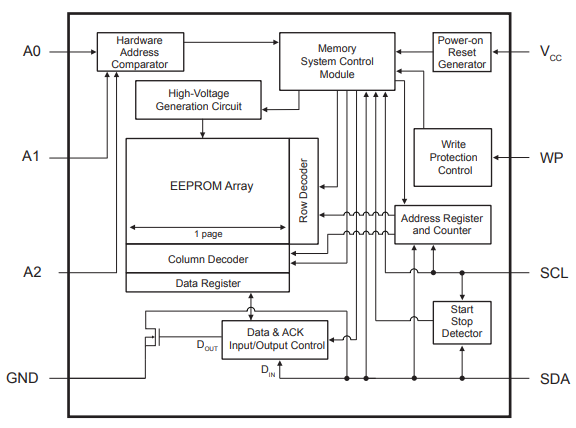
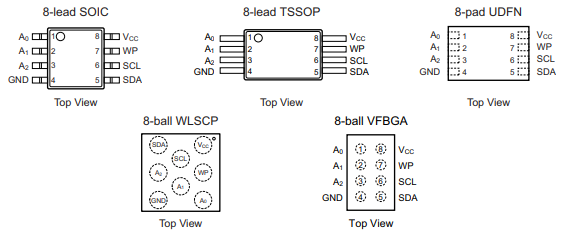
The AT24C512C-SSHM-B provides 524,288 bits of Serial Electrically Erasable and Programmable Read-Only Memory (EEPROM) organized as 65,536 words of 8 bits each. The device’s cascading feature allows up to eight devices to share a common two‑wire bus. The device is optimized for use in many industrial and commercial applications where low‑power and low‑voltage operation are essential. The devices are available in space‑saving 8‑lead SOIC, 8‑lead SOIJ, 8‑lead TSSOP, 8‑pad UDFN, 8-ball WLCSP and 8‑ball VFBGA packages. All packages operate from 1.7V to 3.6V or 2.5V to 5.5V.
2. Features
1. Low voltage and standard voltage operation:
– VCC = 1.7V to 3.6V
– VCC = 2.5V to 5.5V
2. Internal arrangement is 65,536 x 8 (512K)
3. Industrial temperature range: -40°C to +85°C
4. I2C compatible (two-wire) serial interface:
– 100 kHz standard mode, 1.7V to 5.5V
– 400 kHz fast mode, 1.7V to 5.5V
– 1 MHz fast mode enhancement (FM +), 2.5V to 5.5V
5. Schmitt trigger, filter input used to suppress noise
6. Two-way data transmission protocol
7. Write protection pin for full array hardware data protection
8. Ultra-low effective current (maximum 3 mA) and standby current (maximum 6μA)
9. 128 byte page write mode:
- Allow partial page write
10. Random and sequential read mode
11. Self-timed write cycle (up to 5 ms)
12. ESD protection> 4,000V
13. High reliability:
- Endurance: 1,000,000 write cycles
- Data retention: 100 years
14. Green packaging options (lead-free/halogen-free/RoHS compliant)
15. Mold sales options: provide wafer form and tape and reel packaging
3. Pin Configurations and Pinouts
4. Device Address Inputs (A0, A1, A2)
The A0, A1 and A2 pins are device address inputs that are hard-wired (directly to GND or to VCC) for compatibility with other two-wire Serial EEPROM devices. When the pins are hard-wired, as many as eight devices may be addressed on a single bus system. A device is selected when a corresponding hardware and software match is true. If these pins are left floating, the A0, A1 and A2 pins will be internally pulled down to GND. However, due to capacitive coupling that may appear in customer applications, Microchip recommends always connecting the address pins to a known state. When using a pull‑up resistor, Microchip recommends using 10 kΩ or less.
5. Ground
The ground reference for the power supply. GND should be connected to the system ground.
6. Serial Data (SDA)
The SDA pin is an open-drain bidirectional input/output pin used to serially transfer data to and from the device. The SDA pin must be pulled high using an external pull-up resistor (not to exceed 10 kΩ in value) and may be wire-ORed with any number of other open-drain or open-collector pins from other devices on the same bus.
7. Serial Clock (SCL)
The SCL pin is used to provide a clock to the device and to control the flow of data to and from the device. Command and input data present on the SDA pin is always latched in on the rising edge of SCL, while output data on the SDA pin is clocked out on the falling edge of SCL. The SCL pin must either be forced high when the serial bus is idle or pulled high using an external pull-up resistor.