Can ship immediately
Due to market price fluctuations,if you need to purchase or consult the price.You can contact us or emial to us: brenda@hongda-ic.com
1. Description
The LM22676MR-5.0/NOPB switching regulator provides all of the functions necessary to implement an efficient high voltage step-down (buck) regulator using a minimum of external components. This easy to use regulator incorporates a 42 V N-channel MOSFET switch capable of providing up to 3 A of load current. Excellent line and load regulation along with high efficiency (> 90%) are featured. Voltage mode control offers short minimum on-time, allowing the widest ratio between input and output voltages. Internal loop compensation means that the user is free from the tedious task of calculating the loop compensation components. Fixed 5 V output and adjustable output voltage options are available. A switching frequency of 500 kHz allows for small external components and good transient response. A precision enable input allows simplification of regulator control and system power sequencing. In shutdown mode the regulator draws only 25 µA (typ). Built in soft-start (500 µs, typ) saves external components. The LM22676 also has built in thermal shutdown, and current limiting to protect against accidental overloads.
2. Features
1. Wide Input Voltage Range: 4.5 V to 42 V
2. Internally Compensated Voltage Mode Control
3. Stable with Low ESR Ceramic Capacitors
4. 120 mΩ N-Channel MOSFET PFM Package
5. 100 mΩ N-Channel MOSFET PSOP-8 Package
6. Output Voltage Options:
- ADJ (Outputs as Low as 1.285 V)
- 5.0 (Output Fixed to 5 V)
7. ±1.5% Feedback Reference Accuracy
8. Switching Frequency of 500 kHz
9. –40°C to 125°C Operating JunctionTemperature Range
10. Precision Enable Pin
11. Integrated Boot-Strap Diode
12. Integrated Soft-Start
13. Fully WEBENCH® Enabled
14. LM22676Q is an Automotive Grade Productthat is AEC-Q100 Grade 1 Qualified (–40°C to+125°C Operating Junction Temperature)
15. SO PowerPAD (Exposed Pad)
16. PFM (Exposed Pad)
3. Applications
1. Industrial Control
2. Telecom and Datacom Systems
3. Embedded Systems
4. Conversions from Standard 24 V, 12 V and 5 V Input Rails
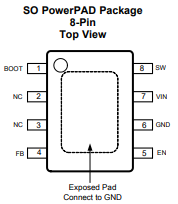
4. Pin Configuration
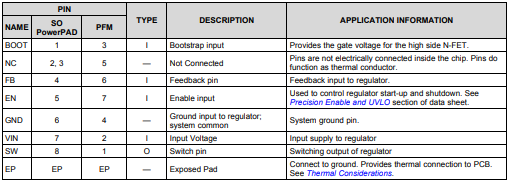
5. Pin Functions