
Can ship immediately
Due to market price fluctuations,if you need to purchase or consult the price.You can contact us or emial to us: brenda@hongda-ic.com
1. Describe
The LM27762DSSR provides very low noise positive and Negative Output Adjustable Between ±1.5 V and ±5 V. The input voltage range is 2.7 V to 5.5 V, Output current up to ±250 mA. with Operating current is only 390 µA and 0.5 µA (typ) shutdown current, the LM27762 provides the ideal Power amplifier and DAC bias performance and Other high current, low noise negative voltage requirements. The device provides a small solution size with almost no external components. Negative voltage is generated by the regulator Inverting charge pump followed by a low noise Negative LDO. inverting charge pump The LM27762 device operates at 2MHz (typ) switching frequency to reduce output resistance and voltage ripple. positive voltage is generated from Input from a low noise positive LDO. The positive and negative outputs of the LM27762 have Dedicated enable input. These outputs support Independent Timing of Positive and Negative Rails For specific system power sequence requirements. enable The inputs can also be shorted together and connected to Input voltage. The LM27762 has an optional Power good function.
2. Feature
1. Generates low noise adjustable positive supply voltage between 1.5 V and 5 V and negative supply voltage between –1.5 V and –5 V
2. Input voltage range 2.7 V to 5.5 V
3. ±250mA output current
4. Inverting charge pump followed by negative LDO
5. 2MHz low noise fixed frequency operation
6. 2.5Ω inverter output impedance, VIN = 5V
7. 30 mV negative LDO dropout at 100 mA, VOUT = –5 V
8. Positive LDO with 45mV dropout at 100mA, VOUT = 5V
9. 390µA Quiescent Current (typ)
10. Shutdown quiescent current of 0.5 µA (typ)
11. Current limit and thermal protection
12. Power good pin (active low)
13. Create custom designs using LM27762 and WEBENCH® Power Designer
3. Application
1. High Definition Audio Headphone Amplifier
2. Op amp power bias
3. Powering data converters
4. Wireless communication system
5. Interface power
6. Handheld instruments
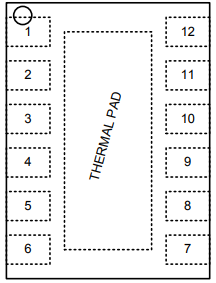
4. Pin configuration
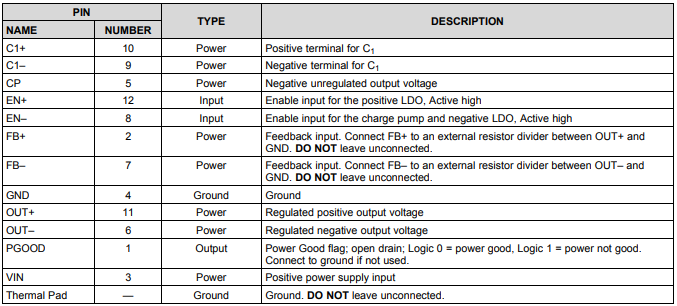
5. Pin Description
6. Feature Description
1. Undervoltage Lockout
The LM27762 has an internal comparator that monitors the voltage at VIN and forces the device into shutdown if the input voltage drops to 2.4 V. If the input voltage rises above 2.6 V, the LM27762 resumes normal operation.
2. Input Current Limit
The LM27762 contains current limit circuitry that protects the device in the event of excessive input current and/or output shorts to ground. The charge pump and positive LDO both have 500 mA (typical) input current limit when the output is shorted directly to ground. When the LM27762 is current limiting, power dissipation in the device is likely to be quite high. In this event, thermal cycling is expected.
3. PFM Operation
To minimize quiescent current during light load operation, the LM27762 allows PFM or pulse-skipping operation. By allowing the charge pump to switch less when the output current is low, the quiescent current drawn from the power source is minimized. The frequency of pulsed operation is not limited and can drop into the sub-2-kHz range when unloaded. As the load increases, the frequency of pulsing increases until it transitions to constant frequency. The fundamental switching frequency in the LM27762 is 2 MHz.
4. Output Discharge
In shutdown, the LM27762 actively pulls down on the outputs (OUT+, OUT–) of the device until the output voltage reaches GND.
5. Thermal Shutdown
The LM27762 implements a thermal shutdown mechanism to protect the device from damage due to overheating. When the junction temperature rises to 150°C (typical), the device switches into shutdown mode. The LM27762 releases thermal shutdown when the junction temperature is reduced to 130°C (typical). Thermal shutdown is most often triggered by self-heating, which occurs when there is excessive power dissipation in the device and/or insufficient thermal dissipation. The LM27762 device power dissipation increases with increased output current and input voltage. When self heating brings on thermal shutdown, thermal cycling is the typical result. Thermal cycling is the repeating process where the part self-heats, enters thermal shutdown (where internal power dissipation is practically zero), cools, turns on, and then heats up again to the thermal shutdown threshold. Thermal cycling is recognized by a pulsing output voltage and can be stopped by reducing the internal power dissipation (reduce input voltage and/or output current) or the ambient temperature. If thermal cycling occurs under desired operating conditions, thermal dissipation performance must be improved to accommodate the power dissipation of the device.
7. Application Information
The LM27762 input voltage range is from 2.7 V to 5.5 V. The positive LDO provides a positive voltage configurable with external gain setting resistors R1, R2. The low-noise charge-pump voltage converter inverts theinput voltage V to a negative output voltage. Charge pump is followed by the negative LDO which regulates a negative output voltage configurable with external

