
Can ship immediately
Due to market price fluctuations,if you need to purchase or consult the price.You can contact us or emial to us: brenda@hongda-ic.com
1. Description
The LM3671 step-down DC-DC converter is optimized for powering low voltage circuits from a single Li-Ion cell battery and input voltage rails from 2.7 V to 5.5 V. It provides up to 600-mA load current, over the entire input voltage range. There are several different fixed voltage output options available as well as an adjustable output voltage version range from 1.1 V to 3.3 V. The device offers superior features and performance for mobile phones and similar portable systems. Automatic intelligent switching between PWM lownoise and PFM low-current mode offers improved system control. During PWM mode, the device operates at a fixed-frequency of 2 MHz (typical). Hysteretic PFM mode extends the battery life by reducing the quiescent current to 16 µA (typical) during light load and standby operation. Internal synchronous rectification provides high efficiency during PWM mode operation. In shutdown mode, the device turns off and reduces battery consumption to 0.01 µA (typical). A high-switching frequency of 2 MHz (typical) allows use of tiny surface-mount components. Only three external surface-mount components, an inductor, and two ceramic capacitors, are required.
2. Features
1. LM3671-Q1 is Qualified for Automotive Applications
2. AEC Q100-Qualified With the Following Results
– Device Temperature Grade 1: –40°C to +125°C Ambient Operating Temperature Range
3. 16-µA Typical Quiescent Current
4. 600-mA Maximum Load Capability
5. 2-MHz PWM Fixed Switching Frequency (Typical)
6. Automatic PFM-PWM Mode Switching
7. Internal Synchronous Rectification for High Efficiency
8. Internal Soft Start
9. 0.01-µA Typical Shutdown Current
10. Operates from a Single Li-Ion Cell Battery
11. Only Three Tiny Surface-Mount External Components Required (One Inductor, Two Ceramic Capacitors)
12. Current Overload and Thermal Shutdown Protection
13. Available in Fixed Output Voltages and Adjustable Version
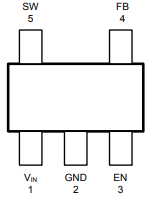
3. Pin configuration
4. Application
1. cell phone
2. Pocket PC
3. MP3 player
4. Wireless LAN
5. Portable instruments
6. Digital camera
7. Portable hard drive
8. car
9. Portable medical equipment
10. Handheld trading terminal
11. Wireless home automation equipment
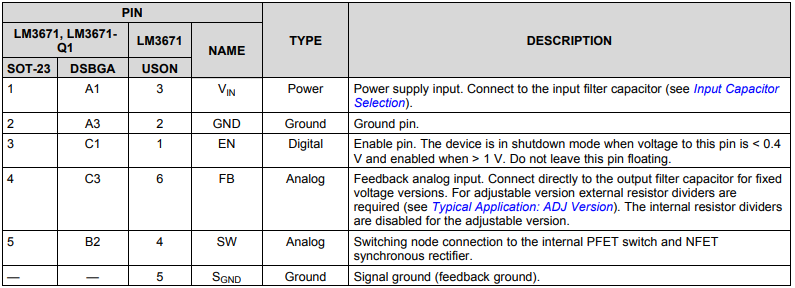
5. Pin Description
6. Function description
1. circuit operation
During the first part of each switching cycle, the control block in the LM3671 turns on the internal PFET switch. This allows current to flow from the input through the inductor to the output filter capacitor and load. Inductors limit current to a ramp with a slope of (VIN – VOUT)/L by storing energy in a magnetic field. During the second part of each cycle, the controller turns off the PFET switch, blocks the current from the input, and turns on the NFET synchronous rectifier. The inductor draws current from ground through the NFET to the output filter capacitor and load, causing the inductor current to drop with a slope of –VOUT/L. The output filter stores charge when the inductor current is high and discharges the charge when the inductor current is low, smoothing the voltage across the load. The output voltage is regulated by modulating the timing of the PFET switching to control the average current sent to the load. The effect is equivalent to sending the duty cycle modulated square wave formed by the switch and synchronous rectifier at the SW pin to the low pass filter formed by the inductor and output filter capacitor. The output voltage is equal to the average voltage of the SW pin.
2. slow start
The LM3671 has a soft-start circuit to limit inrush current during startup. During startup, the switch current limit is gradually increased. Soft-start is only activated when EN goes from logic low to logic high after Vin reaches 2.7V. Soft-start is achieved by increasing the switch current limit in steps of 70 mA, 140 mA, 280 mA, and 1020 mA (typical switch current limit). Therefore, the startup time depends on the output capacitance and the load current required at startup. Typical start-up time is 400 µs with 10 µF output capacitor and 300 mA load, and 275 µs with 1 mA load.

