
Can ship immediately
Due to market price fluctuations,if you need to purchase or consult the price.You can contact us or emial to us: brenda@hongda-ic.com
1. Describe
The LM5165DRCT device is a compact, easy-to-use 3V to 65V, Ultra-Low IQ Synchronous Buck Converter with High Efficiency Over Wide Input Voltage and Load Range Current range. with integrated high and low end Power MOSFET, up to 150mA output current can with a fixed output voltage of 3.3 V or 5 V or at adjustable output. The converter is designed to Simplifies implementation while providing options Optimize the performance of the target application. Select Pulse Frequency Modulation (PFM) mode For best light-load efficiency or constant on-time (COT) controls a nearly constant operating frequency. Neither control scheme requires looping compensated while providing excellent line and load Large transient response and short PWM on-time Buck conversion rate. High-side P-channel MOSFETs can operate at 100% duty cycle minimum dropout voltage Bootstrap capacitors for gate drive are not required. return, Current limit set point adjustable for optimization Inductor selection for specific output current Require. Selectable and adjustable start-up time Options include minimum delay (no soft start), Internally fixed (900 µs) and externally programmable Use capacitive soft-start. Open Drain PGOOD Indicators can be used for sorting, fault reporting, and output voltage monitoring. LM5165 Buck The converter is a 10-pin, 3-mm × 3-mm, 0.5mm Thermally Enhanced VSON-10 Package pin spacing.
2. Feature
1. Wide input voltage range from 3 V to 65 V
2. 10.5µA no-load quiescent current
3. –40°C to 150°C Junction Temperature Range
4. Fixed (3.3 V and 5 V) or adjustable output voltage
5. Complies with EN55022 / CISPR 22 EMI standards
6. Integrated 2-Ω PMOS buck switch
– Supports 100% duty cycle for low dropout
7. Integrated 1-Ω NMOS synchronous rectifier
– No need for external rectifier diodes
8. Programmable current limit set point (four levels)
9. Selectable PFM or COT mode operation
10. 1.223V ±1% internal voltage reference
11. 900-µs internal or programmable soft-start
12. Active slew rate control for low EMI
13. Diode emulation mode and pulse skipping for ultra-high light load efficiency performance
14. Monotonic startup to pre-biased output
15. No loop compensation or bootstrap components
16. Precision enable and input UVLO with hysteresis
17. Pin-to-pin compatible with LM5166
18. Thermal shutdown protection with hysteresis
19. 10-pin, 3-mm × 3-mm VSON package
20. Faster time to market with TPSM265R1 module
21. Create custom regulator designs using WEBENCH® Power Designer
3. Application
1. 4–20 mA loop powered sensor
2. Automotive and battery powered devices
3. High voltage LDO replacement
4. Industrial Control Systems
5. Universal bias supply
4. Pin configuration
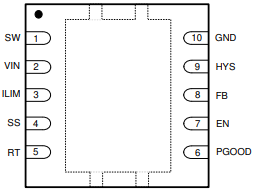
5. Pin Description
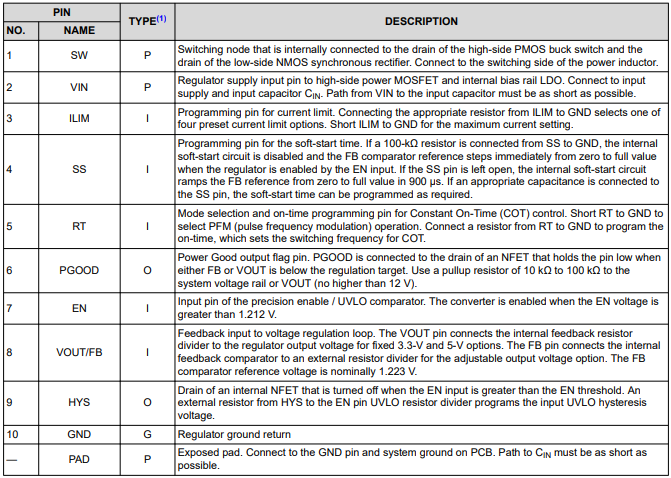
6. Function description
1. Integrated power MOSFET
The LM5165 is a buck converter that integrates a high-side PMOS buck switch and a low-side NMOS synchronous switch. During the on-time of the high-side MOSFET, the SW voltage VSW swings to approximately VIN and the inductor current increases with the slope (VIN – VOUT)/LF. When the control logic turns off the high-side MOSFET, the low-side MOSFET turns on after an adaptive dead time. The inductor current flows through the low- side MOSFET with a slope of –VOUT/LF. The duty cycle D is defined as TON/TSW, where TON is the high-side MOSFET on-time and TSW is the switching period.
2. Selectable PFM or COT Mode Converter Operation
When RT is shorted to GND, the LM5165 operates in PFM mode. So configured, the LM5165 behaves as a hysteretic voltage regulator operating in boundary conduction mode, controlling the output voltage within the upper range to reduce the hysteresis level based on 10 mV of PFM feedback comparator hysteresis. The LM5165 provides the required switching pulses to recharge the output capacitors, followed by a sleep period where most of the internal circuitry is turned off. During this time the load current is supported by the output capacitor, and the LM5165 consumes nearly 10.5 µA of sleep quiescent current. The sleep period duration depends on the load current and output capacitance. Configured in COT mode, the LM5165-based converter turns on the high-side MOSFET with a reverse conduction time proportional to VIN and operates at a substantially fixed switching frequency (CCM) in continuous conduction mode. Diode Emulation Mode (DEM) prevents negative inductor currents and keeps pulse skipping at maximum by reducing the effective switching frequency to improve efficiency at light load currents.
3. COT Mode Light-Load Operation
Diode emulation mode (DEM) operation occurs when the low-side MOSFET switches off as inductor valley current reaches zero. Here, the load current is less than half of the peak-to-peak inductor current ripple in CCM. Turning off the low-side MOSFET at zero current reduces switching loss, and preventing negative current conduction reduces conduction loss. Power conversion efficiency is thus higher in a DEM converter than an equivalent forced-PWM CCM converter. With DEM operation, the duration that both power MOSFETs remain off progressively increas as load current decreases.
4. Low Dropout Operation and 100% Duty Cycle Mode
The LM5165 offers a low input voltage to output voltage dropout by engaging the high-side MOSFET at 100% duty cycle. In COT mode, a frequency foldback feature effectively extends maximum duty cycle to 100% during low dropout conditions or load-on transients. Based on the 4-mV FB comparator dropout hysteresis, the duty cycle extends as needed at low input voltage conditions, corresponding to lower switching frequency. The PWM on-time extends based on the requirement that the FB voltage exceeds the dropout hysteresis during a given on-time. 100% duty cycle operation is eventually reached as the input voltage decreases towards the output setpoint. The output voltage stays in regulation at a lower supply voltage, thus achieving an extremely low dropout voltage.
5. Adjustable Output Voltage (FB)
Three voltage feedback options are available: the fixed 3.3-V and 5-V versions include internal feedback resistors that sense the output directly through the VOUT pin; the adjustable voltage option senses the output through an external resistor divider connected from the output to the FB pin. The LM5165 voltage regulation loop regulates the output voltage by maintaining the FB voltage equal to the internal reference voltage, VREF1. A resistor divider programs the ratio from output voltage VOUT to FB. For a target VOUT setpoint, calculate RFB2 based on the selected RFB1 using Equation 5. Selecting RFB1 in the range of 100 kΩ to 1 MΩ is recommended for most applications. A larger RFB1 consumes less DC current, which is mandatory if light-load efficiency is critical. However, RFB1 larger than 1 MΩ is not recommended as the feedback path becomes more susceptible to noise. High feedback resistances generally require more careful feedback path PCB layout. It is important to route the feedback trace away from the noisy area of the PCB. For more layout recommendations, see Layout.
6. Adjustable Current Limit
The LM5165 manages overcurrent conditions by cycle-by-cycle current limiting of the peak inductor current. The current sensed in the high-side MOSFET is compared every switching cycle to the current limit threshold set by the ILIM pin. Current is sensed after a leading-edge blanking time following the high-side MOSFET turnon transition. The propagation delay of current limit comparator is 100 ns. Four programmable peak current levels are available: 60 mA, 120 mA, 180 mA and 240 mA, corresponding to resistors of 100 kΩ, 56.2 kΩ, 24.9 kΩ and 0 Ω connected at the ILIM pin, respectively. In turn, 25-mA, 50-mA, 75-mA, and 100-mA output current levels in boundary conduction mode PFM operation are possible, respectively. Note that in PFM mode, the inductor current ramps from zero to the chosen peak threshold every switching cycle. Consequently, the maximum output current is equal to half the peak inductor current. Meanwhile, the corresponding output current capability in COT mode is higher as the ripple current is determined by the input and output voltage and the chosen inductance.
7. Functional mode
1. Shutdown mode
The EN pin provides ON and OFF control for the LM5165. When VEN is below approximately 0.6 V, the device is in shutdown mode. Both the internal LDO and switching regulator are turned off. Quiescent current in shutdown mode drops to 4.6 µA at VIN = 12 V. The LM5165 also features internal bias rail undervoltage protection. If the internal bias supply voltage is below its UV threshold, the regulator remains off.
2. Standby mode
The enable threshold of the internal bias rail LDO is lower than the regulator itself. When VEN is above 0.6 V and
Below the precision enable threshold (typically 1.212 V), the internal LDO turns on and regulates. Accuracy Once the internal VCC is above its UV threshold, the enable circuit turns on. Switching and voltage regulation are not enabled until VEN rises above the accuracy enable threshold.
3. Active Mode in COT
When VEN is above the precision enable threshold and the internal bias rail is above its UV threshold. In COT active mode, the LM5165 is in one of three modes, depending on the current load
1. CCM ripple with fixed switching frequency when the load current is higher than half of the peak-to-peak inductor current;
2. Pulse skipping and diode emulation mode (DEM) when the load current is less than half the peak-to-peak value Inductor current ripple in CCM operation.
- See COT More Lightweight Operations for more details;
3. Frequency Foldback Mode Maintains Output Regulation at Low Dropout and Improves Load Transients Reply.
- See Low Dropout Operation and 100% Duty Cycle Mode for details.
4. Active Mode in PFM
Likewise, when VEN and the internal bias rail are above the relevant voltages, the LM5165 is at the PFM active mode threshold, FB has dropped below the lower hysteresis level (VREF1), and boundary conduction mode is charging the output capacitor to the upper hysteresis Voltage flat (VREF2). There is a 4µs wake-up delay state from sleep to activity.
5. Sleep Mode in PFM
When VEN and the internal bias rail are above the relevant threshold levels, the LM5165 is in PFM sleep mode, VFB has exceeded the upper hysteresis limit (VREF2), and the output capacitor supplies the load current. In PFM sleep mode, the LM5165 operates with very low quiescent current.
8. Application Information
The LM5165DRCT converts a wide range of supply voltages to fixed The output voltage. To speed up and simplify the design process for LM5165-based converters, A comprehensive LM5165 Quick Start Design Tool is available for download to help designers design components for a given application. WEBENCH® online software can also be used to generate complete designs, utilize iterative design procedures and access a comprehensive component database. The following sections discuss the design process for COT and PFM modes using specific circuit design examples. As mentioned earlier, the LM5165 also integrates several optional features to meet system design requirements, including precision enable, UVLO, programmable soft-start, programmable switching frequency COT mode, adjustable current limit, and a PGOOD indicator. Each application includes these functions as a more comprehensive design is required.

