
Can ship immediately
Due to market price fluctuations,if you need to purchase or consult the price.You can contact us or emial to us: brenda@hongda-ic.com
1. Description
The LTC2057IS8#TRPBF is a high voltage, low noise, zero-drift operational amplifier that offers precision DC performance over a wide supply range of 4.75V to 36V or 4.75V to 60V for the LTC2057HV. Offset voltage and 1/f noise are suppressed, allowing this amplifier to achieve a maximum offset voltage of 4μV and a DC to 10Hz input noise voltage of 200nVP-P (typ). The LTC2057’s self-calibrating circuitry results inlowoffset voltagedriftwithtemperature, 0.015μV/°C (max), and zero-drift over time. The amplifier also features an excellent power supply rejection ratio (PSRR) of 160dB and a common mode rejection ratio (CMRR) of 150dB (typ). The LTC2057 provides rail-to-rail output swing and an input common mode range that includes the V– rail (V– –0.1V to V+ – 1.5V). In addition to low offset and noise, this amplifier features a 1.5MHz (typ) gain-bandwidth product and a 0.45V/μs (typ) slew rate. Wide supply range, combined with low noise, low offset, and excellent PSRR and CMRR make the LTC2057 and LTC2057HV well suited for high dynamic-range test, measurement, and instrumentation systems.
2. Features
1. Supply Voltage Range
- 4.75V to 36V (LTC2057)
- 4.75V to 60V (LTC2057HV)
2. Offset Voltage: 4μV (Maximum)
3. Offset Voltage Drift: 0.015μV/°C (Maximum, –40°C to 125°C)
4. Input Noise Voltage
- 200nVP-P, DC to 10Hz (Typ)
- 11nV/√Hz, 1kHz (Typ)
5. Input Common Mode Range: V– – 0.1V to V+ – 1.5V
6. Rail-to-Rail Output
7. Unity Gain Stable
8. Gain Bandwidth Product: 1.5MHz (Typ)
9. Slew Rate: 0.45V/μs (Typ)
10. AVOL: 150dB (Typ)
11. PSRR: 160dB (Typ)
12. CMRR: 150dB (Typ)
14. Shutdown Mode
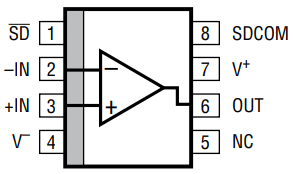
3. Pin configuration
4. Applications
1. High Resolution Data Acquisition
2. Reference Buffering
3. Test and Measurement
4. Electronic Scales
5. Thermocouple Amplifiers
6. Strain Gauges
7. Low-Side Current Sense
8. Automotive Monitors and Control
5. Electrical Characteristics
1. Stresses beyond those listed under Absolute Maximum Ratings may cause permanent damage to the device. Exposure to any Absolute Maximum Rating condition for extended periods may affect devicereliability and lifetime.
2. The LTC2057I/LTC2057HVI are guaranteed to meet specified performance from –40°C to 85°C. The LTC2057H/LTC2057HVH are guaranteed to meet specified performance from –40°C to 125°C.
3. These parameters are guaranteed by design. Thermocouple effects preclude measurements of these voltage levels during automated testing. VOS is measured to a limit determined by test equipment capability.
4. These specifications are limited by automated test system capability. Leakage currents and thermocouple effects reduce test accuracy. For tighter specifications, please contact LTC Marketing.
5. Minimum specifications for these parameters are limited by the capabilities of the automated test system, which has an accuracy of approximately 10µV for VOS measurements. For reference, 10µV/60V is 136dB, 10µV/30V is 130dB, and 10µV/5V is 114dB.
6. Applications Information
The DC average of injection current is the specified input bias current, but this current has a frequency component at the chopping frequency as well. When these small current pulses, typically about 0.7nARMS, interact with source impedances or gain setting resistors, the resulting voltage spikes are amplified by the closed loop gain. For high impedances, this may cause the 100kHz chopping frequency to be visible in the output spectrum, which is a phenomenon known as clock feed-through. For zero-drift amplifiers, clock feed-through will be proportional to source impedance and the magnitude of injection current, a measure of which is IB at 25°C. In order to minimize clock feed-through, keep gain-setting resistors and source impedances as low as possible. If high impedances are required, place a capacitor across the feedback resistor to limit the bandwidth of the closed loop gain. Doing so will effectively filter out the clock feed-through signal. Injection currents from the two inputs are of equal magnitude but opposite direction. Therefore, input bias current effects due to injection currents will not be canceled by placing matched impedances at both inputs. Above 75°C, leakageoftheESDprotectiondiodesbegins to dominate the input bias current and continues to increase exponentially at elevated temperatures. Unlike injection current, leakage currents are in the same direction for both inputs. Therefore, the output error due to leakage currents can be mitigated by matching the source impedances seen by the two inputs.

