
Can ship immediately
Due to market price fluctuations,if you need to purchase or consult the price.You can contact us or emial to us: brenda@hongda-ic.com
1. Description
The MAX9075EUK-T/MAX9077 single/dual comparators are optimized for 3V and 5V single-supply applications. These comparators have a 580ns propagation delay and consume just 3µA per comparator. The combination of low-power, single-supply operation down to 2.1V, and ultra-small footprint makes these devices ideal for all portable applications. The MAX9075/MAX9077 have a common-mode input voltage range of -0.2V to VCC - 1.2V. Unlike many comparators, there is no differential clamp between the inputs, allowing the differential input voltage range to extend rail-to-rail. All inputs and outputs tolerate a continuous short-circuit fault condition to either rail. The design of the output stage limits supply-current surges while switching (typical of many other comparators), minimizing power consumption under dynamic conditions. Large internal push-pull output drivers allow rail-to-rail output swing with loads up to 2mA, making these devices ideal for interface with TTL/CMOS logic. The MAX9075 single comparator is available in 5-pin SC70 and SOT23 packages, while the MAX9077 dual comparator is available in 8-pin SOT23, µMAX®, and SO packages.
2. Features
1. 580ns Propagation Delay from Only 3µA
2. 2.1V to 5.5V Single-Supply Operation
3. Ground-Sensing Inputs
4. Rail-to-Rail Outputs
5. No Output Phase Inversion for Overdriven Inputs
6. No Differential Clamp Across Inputs
7. Available in Ultra-Small Packages
- 5-Pin SC70 (MAX9075)
- 8-Pin SOT23 (MAX9077)
3. Applications
1. Battery-Powered Systems
2. Threshold Detectors/Discriminators
3. Keyless Entry Systems
4. IR Receivers
5. Digital Line Receivers
4. Pin Configurations
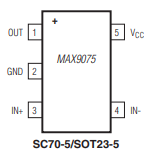
5. Detailed description
MAX9075/MAX9077 have 580ns propagation Delay from ultra-low supply current of 3µA each Comparators. These devices are capable of single-supply operation from 2.1V to 5.5V. Large interior The output driver allows rail-to-rail output swings up to 2mA load. Both comparators provide push-pull output Sink and source current.
6. Comparator output
MAX9075/MAX9077 are designed to maintain By limiting the through current, low power supply current is provided during repeated conversions.
7. Application information
Hysteresis expands the noise tolerance of the comparator Increase the upper threshold and decrease The threshold is low. Voltage divider from the output The comparator sets the trip voltage. Therefore, this trip The voltage is related to the output voltage. Use positive feedback to set the hysteresis of the three resistors. The design process is as follows:
1) Select R3. The leakage current of IN+ may cause Minor error; however, the current through R3 can be About 500nA and still maintain accuracy. Because the circuit is in The trip point is VCC/R3; 10MΩ is a good practical value For R3, because this makes the current much lower than the chip's power supply current.
2) Select the hysteresis voltage (VHYS), namely The voltage between the upper and lower thresholds. exist In this example, choose VHYS = 50mV and assume VREF = 1.2V and VCC = 5V.
3) Calculate R1 as follows: R1 = R3 x VHYS/VCC = 10MΩ x 0.05/5 = 100kΩ

