
Can ship immediately
Due to market price fluctuations,if you need to purchase or consult the price.You can contact us or emial to us: brenda@hongda-ic.com
1. Description
The OPA170AIDBVR, OPA2170, and OPA4170 devices (OPAx170) are a family of 36-V, single-supply, lownoise operational amplifiers (op amps) that feature micro packages with the ability to operate on supplies ranging from 2.7 V (±1.35 V) to 36 V (±18 V). They offer good offset, drift, and bandwidth with low quiescent current. The single, dual, and quad versions all have identical specifications for maximum design flexibility. Unlike most op amps, which are specified at only one supply voltage, the OPAx170 family of op amps is specified from 2.7 V to 36 V. Input signals beyond the supply rails do not cause phase reversal. The OPAx170 family is stable with capacitive loads up to 300 pF. The input can operate 100 mV below the negative rail and within 2 V of the positive rail for normal operation. Note that these devices can operate with full rail-to-rail input 100 mV beyond the positive rail, but with reduced performance within 2 V of the positive rail. The OPAx170 op amps are specified from –40°C to +125°C.
2. Features
1. Supply Range: 2.7 V to 36 V, ±1.35 V to ±18 V
2. Low Noise: 19 nV/√Hz
3. RFI Filtered Inputs
4. Input Range Includes the Negative Supply
5. Input Range Operates to Positive Supply
6. Rail-to-Rail Output
7. Gain Bandwidth: 1.2 MHz
8. Low Quiescent Current: 110 µA per Amplifier
9. High Common-Mode Rejection: 120 dB
10. Low Bias Current: 15 pA (Maximum)
11. Industry-Standard Packages and micro Packages Available
12. Create a Custom Design Using the OPAx170 With the WEBENCH® Power Designer
3. Applications
1. Tracking Amplifier in Power Modules
2. Merchant Power Supplies
3. Transducer Amplifiers
4. Bridge Amplifiers
5. Temperature Measurements
6. Strain Gauge Amplifiers
7. Precision Integrators
8. Battery-Powered Instruments
9. Test Equipment
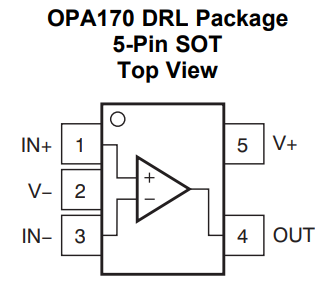
4. Pin configuration
5. Pin description
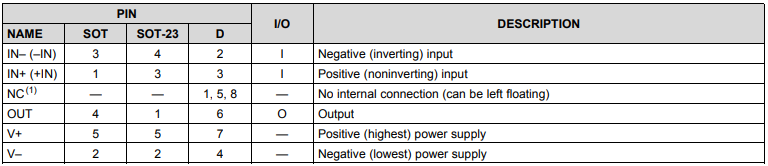
6. Function description
Another common question concerns what happens to the amplifier if the input signal is applied to the input The power supply (V+ or V–) is 0 V. Again, this problem depends on the power supply characteristics at 0 V, Or a level lower than the amplitude of the input signal. If the power supply shows high impedance, the input source The operational amplifier current is provided through the current control diode. This state is not a normal prejudice Health condition; most likely, the amplifier is not working properly. If the power supply is low impedance, the current It can become quite high by turning the diode. The current level depends on the capability of the input source To provide current and any resistance in the input path. If there is any uncertainty about the power supply’s ability to absorb this current, add an external Zener diode to the power supply Power supply pin. Choose the Zener voltage so that the diode does not conduct during normal operation. However, the Zener voltage must be low enough so that the Zener diode turns on when the power pin starts to rise Higher than the power supply voltage level for safe operation. OPAx170 input pins are protected from excessive differential voltage through back-to-back diodes; in most circuit applications, the input protection circuit does not work. However, at low gain or G = 1 In the circuit, the fast ramp input signal can forward bias these diodes because the output of the amplifier cannot The response speed to the input ramp is fast enough. If the input signal is fast enough to produce this forward bias condition, Limit the input signal current to 10 mA or less. If the input signal current itself is not limited, the input is connected in series The resistor can be used to limit the input signal current. The input series resistance reduces low noise The performance of OPAx170.
7. Electrical overload
Designers often ask questions about the ability of operational amplifiers to withstand electrical overloads. These problems are often concentrated on the input end of the device, but may involve the power supply voltage pin or even the output end pin. Each of these different pin functions has the characteristics of a specific semiconductor manufacturing process and a specific circuit connected to the pin by electrical stress determined by voltage breakdown. In addition, these circuits have built-in internal electrostatic discharge (ESD) protection to protect them from Unexpected ESD events before and during product assembly. It is helpful to fully understand this basic ESD circuit and its relevance to electrical overload events. The electrostatic discharge protection circuit includes several current control diodes, which are connected from the input and output pins and routed back to the internal power line. The diodes are connected to the amplifier at the absorption device inside the work. The protection circuit is designed to remain inactive during normal circuit operation.
8. Reverse protection
The OPAx170 series has internal reverse phase protection. Many op amps exhibit phase Reverse when the input is driven beyond its linear common mode range. This situation is most common When the input is driven beyond the specified common-mode voltage range, encountered in the non-inverting circuit, Reverse the output to the opposite track. OPAx170 input prevents phase reversal The common mode voltage is too high. Instead, the output is limited to the appropriate track.

