
Can ship immediately
Due to market price fluctuations,if you need to purchase or consult the price.You can contact us or emial to us: brenda@hongda-ic.com
1. Describe
The SN6505BDBVR is a low noise, low EMI push-pull transformer driver designed for small form factor isolated power supplies. It can drive a 2.25 V to 5 V DC power supply. Ultra-low noise and EMI are achieved through spread spectrum (SSC) slew rate control of the output switch voltage and clock. The SN6505x consists of an oscillator and a gate drive circuit that provides complementary output signals to drive ground-referenced N-channel power switches. The device includes two 1A power MOSFET switches to ensure startup under heavy loads. Switching clocks can also be obtained externally for precise placement of switching harmonics, or when working with multiple transformer drivers. Internal protection features include 1.7 A current limit, undervoltage lockout, thermal shutdown, and break-before-make circuitry. The SN6505x includes a soft-start feature that prevents high inrush currents during heavy-load power-up capacitors. The SN6505A has a 160 kHz internal oscillator ideal for applications requiring minimal emissions while the SN6505B has a 420 kHz internal oscillator for applications requiring higher efficiency and smaller transformer size. The SN6505x is available in a small 6-pin SOT23/DBV package. Device operation is characterized by a temperature range of –55°C to 125°C.
2. Feature
1. Transformer push-pull driver
2. Wide input voltage range: 2.25 V to 5.5 V
3. High output drive: 1 A at 5 V supply
4. Low RON 0.25 Ω (max 4.5 V supply)
5. Ultra low EMI
6. Spread Spectrum Clocking
7. Precision internal oscillator options: 160 kHz (SN6505A) and 420 kHz (SN6505B)
8. Synchronization of multiple devices to an external clock input
9. Slew rate control
10. 1.7 A current limit
11. Low Shutdown Current: <1 μA
12. Thermal shutdown
13. Wide temperature range: –55°C to 125°C
14. Small 6-pin SOT23 (DBV) package
15. Soft start to reduce inrush current
3. Application
1. CAN, RS-485, RS-422, RS-232, SPI, I2C, Low Power LAN
2. Low noise isolated USB power
3. Process control
4. Telecom supplies
5. Radio supplies
6. Distribute supplies
7. medical instruments
8. precision instrument
9. Low noise filament power supply
4. Pin configuration
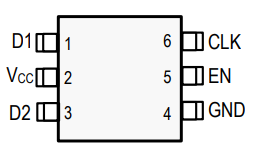
5. Pin Description
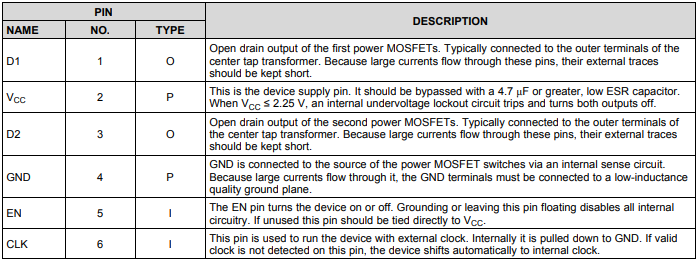
6. Function Description
Push-pull converters require a center-tapped transformer to transfer power from the primary to the secondary. When Q1 is on, VIN drives current through the lower half of the primary to ground, creating a negative voltage potential at the lower end of the primary to the center-tapped VIN potential. At the same time, the voltage on the upper half of the primary makes the upper side of the primary positive with respect to the center tap to maintain the previously established current through Q2, which now becomes high impedance. Two voltage sources, each equal to VIN, appear in series and cause 2×VIN Primary open circuit terminal to ground voltage. By convention, the same voltage polarity that appears on the primary also appears on the secondary. Therefore, the positive potential on the upper secondary side forward biases diode CR1. Secondary current from the upper secondary side flows through CR1, charges capacitor C, and returns to the center tap through load impedance RL. When Q2 is turned on, Q1 becomes high impedance and the voltage polarity of the primary and secondary is reversed. The lower end of the primary now presents an open circuit with a potential of 2 × VIN to ground. In this case, CR2 is forward biased, CR1 is reverse biased, and current flows from the secondary side through CR2, charging the capacitor and returning to the center tap through the load.
When Q1 turns on, the flux pushes from A to A' and when Q2 pulls the flux from A' back to A. The product of the magnetic flux difference and the magnetic flux density difference with the primary voltage VP and time tON, applied to the primary: B ≈ VP × tON. This volt-second (V-t) product is important because it determines the core magnetization during each switching cycle. If the V-t products of the two phases are not the same, an imbalance in the flux density swing results from the start of the B-H curve. If balance is not restored, the offset will increase with each subsequent cycle and the transformer will slowly saturate.
7. Application Information
The SN6505 is a transformer driver designed for low cost, small form factor, isolated DC/DC converters in a push-pull topology. The device includes an oscillator that powers the gate drive circuit. The gate driver, consisting of a frequency divider and a break-before-make (BBM) logic, provides two complementary output signals that alternately turn on the two output transistors. The output frequency of the oscillator is divided by an asynchronous divider, providing two complementary output signals S and S with a 50% duty cycle. The subsequent break-before-make logic inserts dead time between the high pulses of the two signals. The resulting output signals G1 and G2 represent the gate drive signals for output transistors Q1 and Q2, before either one of the gates can assume logic high, there must be a short time period during which both signals are low and both transistors are high impedance. This short period, known as break-before-make time, is required to avoid shorting out both ends of the primary.

