
Can ship immediately
Due to market price fluctuations,if you need to purchase or consult the price.You can contact us or emial to us: brenda@hongda-ic.com
1. Describe
The SN65HVD1050DR meets or exceeds Specifications used in the ISO 11898 standard Applications using Controller Area Network (CAN). As a CAN transceiver, the device provides differential Transmit capability to bus and differential receive Capability of CAN controllers at signaling rates 1 megabit per second (Mbps) The SN65HVD1050 is designed for use in Especially in harsh environments. Therefore, the device With cross-wire, overvoltage and ground loss Protection from –27 V to 40 V, overheating Shutdown, –12V to 12V Common Mode Range, and Withstands voltage transients from –200 V to 200 V According to ISO 7637.
Pin 8 provides two different modes of operation: high speed or silent mode. High-speed operation mode is selected by grounding S (pin 8). If a high logic level is applied to the S pin of the SN65HVD1050, the device enters a listen-only mute mode during which the driver is turned off while the receiver remains fully functional. In silent mode, all bus activity is passed from the receiver output to the local protocol controller. When data transfer is required, the local protocol controller reverses this low current silent mode by bringing the S pin to a logic low level to resume full operation. The primary timeout circuit in the SN65HVD1050 prevents the driver from blocking network communications due to hardware or software failures. The time-out circuit is triggered by a falling edge on TXD (pin 1). If no rising edge is seen before the circuit's timeout constant expires, the driver is disabled. The circuit is then reset by the next rising edge of TXD. Vref (pin 5) can be used as a VCC/2 voltage reference to stabilize the output common mode voltage point. The SN65HVD1050 operates from –40°C to 125°C
2. Feature
1. Improved replacement for TJA1050
2. High Electromagnetic Immunity (EMI)
3. Very low Electromagnetic Emissions (EME)
4. Meets or exceeds ISO 11898-2 requirements
5. CAN bus fault protection from –27 V to 40 V
6. Explicit timeout function
7. Glitch-free CAN bus input and output on power-up and power-down
– High input impedance with low VCC
– Monotonic output during power cycling
3. Application
1. automated industry
– DeviceNet™ data bus (Vendor ID #806)
2. SAE J2284 high-speed CAN bus for automotive applications
3. SAE J1939 standard data bus interface
4. ISO 11783 standard data bus interface
5. NMEA 2000 standard data bus interface
4. Pin configuration
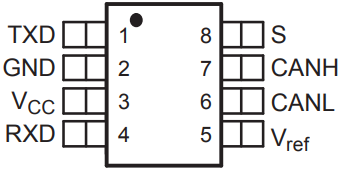
5. Pin Description
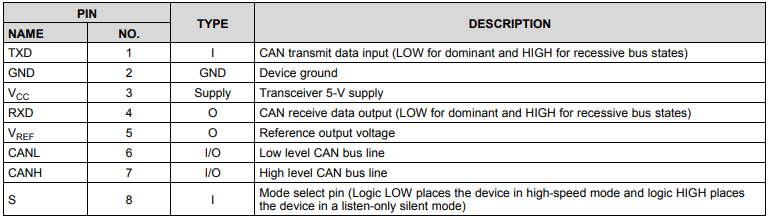
6. Feature Description
1. Normal Mode
Select the normal mode of the device operation by setting the S pin low. The CAN bus driver and receiver are fully operational and the CAN communication is bidirectional. The driver is translating a digital input on TXD to a differential output on CANH and CANL. The receiver is translating the differential signal from CANH and CANL to a digital output on RXD
2. TXD Dominant Timeout (DTO)
During normal mode, the mode where the CAN driver is active, the TXD DTO circuit prevents the transceiver from blocking network communication in the event of a hardware or software failure where TXD is held dominant longer than the timeout period tTXD_DTO. The DTO circuit is triggered on a falling edge on the driver input, TXD. The DTO circuit disables the CAN bus driver if no rising edge is seen on TXD before the timeout period expires. This frees the CAN bus for communication between other nodes on the network. The CAN driver is re-enabled when a rising edge is seen on the drvier input, TXD, thus clearing the TXD DTO condition. The receiver and RXD pin still reflect the CAN bus, and the bus pins are biased to recessive level during a TXD DTO.
3. Thermal Shutdown
The SN65HVD1050 has a thermal shutdown feature that turns off the driver outputs when the junction temperature nears 190°C. This shutdown prevents catastrophic failure from bus shorts, but does not protect the circuit from possible damage. The user should strive to maintain recommended operating conditions and not exceed absolute-maximum ratings at all times. If an SN65HVD1050 is subjected to many, or long-duration faults that can put the device into thermal shutdown, it should be replaced.
7. Application Information
The CAN bus has two states during powered operation of the device; dominant and recessive. A dominant bus state is when the bus is driven differentially, corresponding to a logic low on the D and R pin. A recessive bus state is when the bus is biased to VCC/2 via the high-resistance internal resistors RIN and RID of the receiver, corresponding to a logic high on the D and R pins.

