
Can ship immediately
Due to market price fluctuations,if you need to purchase or consult the price.You can contact us or emial to us: brenda@hongda-ic.com
1. Describe
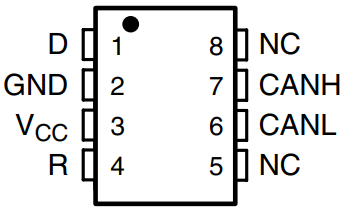
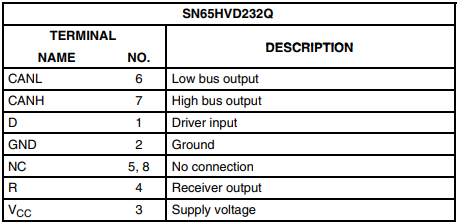
The SN65HVD230Q, SN65HVD231Q, and SN65HVD232QDRG4Q1 Controller Area Network (CAN) transceivers are designed for use with Texas Instruments TMS320Lx240x 3.3-V DSPs or equivalent devices with CAN controllers. They are intended for use in applications using the CAN serial communication physical layer according to the ISO 11898 standard. Each CAN transceiver is designed to provide differential functionality for the bus and differential receive functionality for the CAN controller at speeds up to 1 Mbps. Designed for operation in particularly harsh environments, these devices feature cross-wire protection, ground loss and overvoltage protection, thermal protection, and a wide common-mode range. This transceiver connects single-ended CAN controllers to differential CAN buses in industrial, building automation, and automotive applications. It has a common-mode voltage range of –2V to 7V on the bus and can withstand ±25V common-mode transients. On the SN65HVD230Q and SN65HVD231Q, RS (pin 8) provides three different operating modes: high-speed, slope-controlled, and low-power modes. High-speed mode of operation is selected by connecting pin 8 to ground, allowing the transmitter output transistors to turn on and off as quickly as possible with no restrictions on the rise and fall slopes. The rising and falling slopes can be adjusted by connecting a resistor at pin 8 to ground, as the slope is proportional to the output current at the pin. This slope control is achieved using external resistor values of 10 kΩ for a 15-V/µs slew rate, to 100 kΩ for a 2-V/µs slew rate. The SN65HVD230Q's circuitry enters a low-current standby mode during which the driver is turned off and the receiver remains active if a high logic level is applied to RS (pin 8). The DSP controller inverts this Low current standby mode when a dominant state occurs on the bus (bus differential voltage > 900 mV typical). The unique difference between the SN65HVD230Q and the SN65HVD231Q is that when a high logic level is applied to RS (pin 8), both the driver and receiver in the SN65HVD231Q are turned off and remain in this sleep mode until the circuit is reactivated by a low level of RS on the logic level. Vref (pin 5 on SN65HVD230Q and SN65HVD231Q) can be used as a VCC/2 voltage reference. The SN65HVD232Q is a basic CAN transceiver with no additional options; pins 5 and 8 are NC, no connections.
2. FEATURES
1. Qualified for Automotive Applications
2. ESD Protection Exceeds 2000 V Per MIL-STD-883, Method 3015; Exceeds 200 V Using Machine Model (C = 200 pF, R = 0)
3. Operates With a 3.3-V Supply
4. Low Power Replacement for the PCA82C250 Footprint
5. Bus/Pin ESD Protection Exceeds 15-kV HBM
6. Controlled Driver Output Transition Times for Improved Signal Quality on the SN65HVD230Q and SN65HVD231Q
7. Unpowered Node Does Not Disturb the Bus
8. Compatible With the Requirements of the ISO 11898 Standard
9. Low-Current SN65HVD230Q Standby Mode 370 µA Typical
10. Low-Current SN65HVD231Q Sleep Mode 0.1 µA Typical
11. Designed for Signaling Rates‡ Up To 1 Megabit/Second (Mbps)
12. Thermal Shutdown Protection
13. Open-Circuit Fail-Safe Design
3. Pin configuration
4. Pin Description
5. Application Information
The bus pins also maintain a high-impedance state at low VCC to ensure glitch-free power-up and power-down bus protection for hot-swap applications. This high impedance condition also means that unpowered nodes do not interfere with the bus. Transceivers without this feature typically have very low output impedance. This creates high current demands when the transceiver is powered down, a condition that can affect the entire bus.
6. High speed mode
High-speed mode can be selected by applying a logic low level to Rs. High-speed operating modes are typically used in industrial applications. High speed allows the output to switch as fast as possible without internal limits on the output rise and fall slopes. The only limitations of high speed operation are cable length and radiated emission issues, each of which is addressed by the slope control mode of operation. If a low-power standby mode is to be used in the circuit, a direct connection to the DSP output pins can be used to toggle between logic low (< 1 V) and logic high (> 0.75 VCC) for high speed mode operation. Standby mode operation.

