Can ship immediately
Due to market price fluctuations,if you need to purchase or consult the price.You can contact us or emial to us: brenda@hongda-ic.com
1. Describe
KEMET's C0G dielectric maximum temperature is 125°C The operating temperature is considered "stable". Electronic components, components and materials The Association (EIA) characterizes C0G dielectrics as Class I materials. The components of this classification are Temperature compensation, suitable for resonance Circuit application or those Q and stability Capacitance characteristics are required. C0G exhibits no The change of capacitance with time and voltage and The change relative to the capacitance is negligible Ambient temperature. The capacitance change is limited to ±30 ppm/ºC, -55°C to +125°C.
2. Feature
1. −55°C to +125°C operating temperature range
2. Lead-free (Pb), compliant with RoHS and REACH standards
3. Environmental impact assessment 0201, 0402, 0603, 0805, 1206, 1210, 1808, 1812, 1825,2220 and 2225 case size
4. The DC voltage ratings are 10 V, 16 V, 25 V, 50 V, 100 V, 200 V and 250 volts
5. Capacitance range from 0.5 pF to 0.47 μF
6. Available capacitance tolerances are ±0.10 pF, ±0.25 pF,±0.5 pF, ±1%, ±2%, ±5%, ±10%, and ±20%
7. No piezoelectric noise
8. Very low ESR and ESL
9. High thermal stability
10. High ripple current capability
3. Benefit
1. The preferred capacitive solution in the line frequency and MHz range
2. Relative to the applied rated DC voltage, the capacitance does not change
3. Relative to the temperature from -55°C to +125°C, the capacitance change is negligible
4. No capacitance decays over time
5. Non-polar device to minimize installation problems
6. 100% pure matte tinned termination finish for excellent solderability
7. SnPb plating termination options are available on request (minimum 5% Pb)
4. Application
Typical applications include critical timing, tuning, circuits that require low loss, pulse circuits, high current, decoupling,Bypass, filtering, transient voltage suppression, blocking and energy storage.
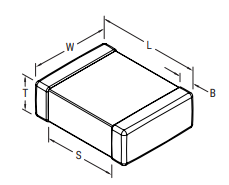
5. Package overview