
Can ship immediately
Due to market price fluctuations,if you need to purchase or consult the price.You can contact us or emial to us: brenda@hongda-ic.com
1. Describe
The TLE2064AIDR series of low-power JFET input operational amplifiers doubles the bandwidth of the previous generation TL06x and TL03x BiFET series without significantly increasing power consumption. The Texas Instruments Excalibur process also provides a lower noise floor than TL06x and TL03x. The fine adjustment of the on-chip Zener offset voltage provides accuracy for DC-coupled applications. TL206x devices are pin-compatible with other Texas Instruments BiFETs; they can be used to double the bandwidth of TL06x, and TL03x circuits can reduce the power consumption of TL05x, TL07x, and TL08x circuits by nearly 90%. BiFET operational amplifiers provide the higher input impedance inherent in JFET input transistors without sacrificing the output drive associated with bipolar amplifiers. This makes them more suitable for high-impedance sensors or low-level AC signals. They also have better AC response than bipolar or CMOS devices with comparable power consumption. The TLE206x series has a high output drive circuit, which can drive a 100Ω load with a power supply as low as ±5V. This makes them particularly suitable for driving modems and other drivers that require good AC characteristics, low power, and high output. Since the BiFET operational amplifier is designed for dual power supplies, it must be noted that when using a single power supply, please pay attention to the common-mode input voltage limit and output swing. DC bias requires an input signal, and the load should be terminated to the virtual ground node of the intermediate power supply. Texas Instruments TLE2426 integrated virtual ground generator is very useful when operating BiFET amplifiers from a single channel Supplies. The rated voltage of TLE206x is ±15 V and ±5 V. For operation in low-voltage and/or single-supply systems, it is recommended to use Texas Instruments LinCMOS series operational amplifiers (TLC and TLV prefixes). When switching from BiFET to CMOS amplifier, special attention should be paid to the slew rate and bandwidth requirements and output load. Texas Instruments TLV2432 and TLV2442 CMOS operational amplifiers are excellent choices worth considering.
2. Feature
1. Twice the bandwidth (2 MHz) of TL06x and TL03x op amps
2. Low supply current... 290 µA/Ch typical
3. On-chip offset voltage adjustment to improve DC performance
4. High output drive, specified as 100Ω load
5. Lower noise floor than previous generations of low-power BiFETs
3. Pin configuration
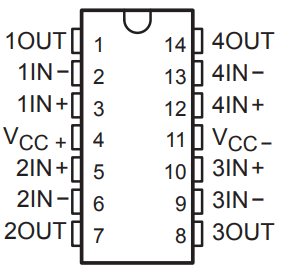
4. Input bias and offset current
At the typical picoamp bias current levels of TLE206x, TLE2064xA and TLE206xB, accurate measurement of the bias current becomes difficult. Not only does this measurement require a picoammeter, but the test socket leakage can easily exceed the actual device bias current. In order to accurately measure these small currents, Texas Instruments has adopted a two-step method. Use a picoammeter to measure the socket leakage and apply a bias voltage, but there is no component in the socket. Then plug the device into the socket Perform the second test to measure the socket leakage current and input bias current of the device. These two measurements are then subtracted algebraically to determine the bias current of the device.
5. Input characteristics
TLE206x, TLE206xA, and TLE206xB specify the minimum and maximum input voltage. If any input voltage exceeds this voltage, it may cause the device to malfunction. Due to the extremely high input impedance and the resulting low bias current requirements, TLE206x, TLE206xA and TLE206xB are very suitable for low-level signal processing. However, the leakage current on the printed circuit board and socket can easily exceed the bias current requirement, resulting in degraded system performance. It is a good practice to include a guard ring around the input (see Figure 44). These protection devices should be driven by a low impedance source with the same voltage level as the common mode input.
6. Application information
1. Maximum positive output voltage swing
2. Maximum negative output voltage swing
3. Slew rate
4. Static power
5. Input bias current
6. Open loop voltage amplification
7. Unity gain frequency
8. Common mode rejection ratio
9. Phase margin
10. DC output resistance
11. AC output resistance
12. Short circuit output current limit

