
Can ship immediately
Due to market price fluctuations,if you need to purchase or consult the price.You can contact us or emial to us: brenda@hongda-ic.com
1. Describe
The TLV62569DBVR device is a synchronous buck Step-Down DC-DC Converters Optimized for High Efficiency and compact solution size. The device integrates capable of providing an output current switch up to 2 A. At medium to heavy loads, the device will Pulse Width Modulation (PWM) mode with 1.5MHz On-off level. At light loads, the device Automatically enter Power Save Mode (PSM) to Maintain high efficiency over the entire load current scope. In the shutdown state, the current consumption is reduced to less than 2 μA. TLV62569 provides adjustable output voltage through an external resistor divider. Internal soft start The circuit limits the inrush current during startup. other Overcurrent protection, thermal protection and other functions Shutdown protection and power good are built in. This The device is available in SOT23 and SOT563 packages.
2. Feature
1. Up to 95% Efficiency
2. Low RDS(ON) switching 100 mΩ / 60 mΩ
3. 2.5V to 5.5V input voltage range
4. Adjustable output voltage from 0.6 V to VIN
5. Power save mode for light load efficiency
6. 100% duty cycle for lowest dropout
7. 35µA operating quiescent current
8. 1.5MHz typical switching frequency
9. Power good output
10. Overcurrent protection
11. Internal soft start
12. Thermal shutdown protection
13. Available in SOT package
14. Pin-to-pin compatible with TLV62568
15. Create custom designs using TLV62569 Using WEBENCH® Power Designer
3. Application
1. Universal POL power supply
2. Set-top box
3. Web video camera
4. Wireless Router
5. Hard disk driver
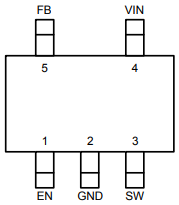
4. Pin configuration
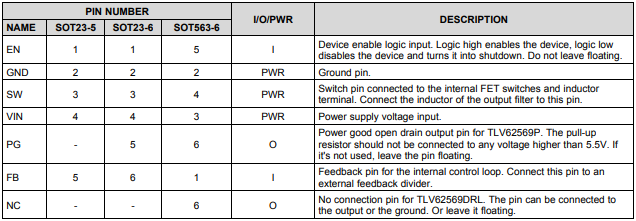
5. Pin Description
6. Function description
1. Power saving mode
The device automatically enters a power-saving mode when the inductor current is too large to improve light-load efficiency become discontinuous. In power save mode, the converter reduces switching frequency and minimizes current consume. In power saving mode, the output voltage is slightly higher than the nominal output voltage. this effect minimized by increasing the output capacitance.
2. Soft start
When the device is enabled, an internal soft-start circuit ramps the output voltage up to the nominal output voltage during startup. This avoids excessive inrush current and produces a smooth output voltage rising slope. It also prevents excessive voltage drop in primary cells and cells with high internal recharge impedance. The TLV62569 is capable of booting into pre-biased output capacitors. The converter starts with an applied bias voltage and ramps the output voltage up to its nominal value.
3. Switch Current Limit
The switch current limit prevents the device from drawing high inductor current and drawing excessive current from the battery or input voltage rail. Excessive current flow may occur when the load is heavy or the output circuit is shorted. The TLV62569 controls peak current by sensing the current in the high-side switch. Once the high-side switch current limit is reached, the high-side switch is turned off and the low-side switch is turned on to reduce the inductor current with an adaptive off-time.
4. Undervoltage lockout
To avoid device misoperation at low input voltages, an undervoltage lockout is implemented, which can be shut down The device has VHYS_UVLO hysteresis at voltages below VUVLO.
5. Thermal shutdown
Once the junction temperature exceeds the thermal shutdown rising threshold, TJSD, the device enters thermal shutdown. Once the junction temperature falls below the falling threshold, the device automatically resumes normal operation.
7. Input and Output Capacitor Selection
The architecture of the TLV62569 allows the use of miniature ceramic-type output capacitors with low equivalent series resistance (ESR). These capacitors provide low output voltage ripple and are therefore recommended. In order to maintain its resistance to high frequencies and achieve a narrow capacitance change with temperature, it is X7R or X5R dielectrics are recommended. The input capacitor is a low-impedance energy source for the converter, helping to provide stable operation. Low ESR multilayer ceramic capacitors are recommended for best filtering. For most applications, a 4.7µF input capacitor is sufficient; larger values reduce input voltage ripple.

