
Can ship immediately
Due to market price fluctuations,if you need to purchase or consult the price.You can contact us or emial to us: brenda@hongda-ic.com
1. Description
The TRS3232ECPWR device consists of two line drivers, two-line receivers, and a dual charge-pump circuit with ±15-kV IEC ESD protection pin to pin (serial-port connection pins, including GND). The device meets the requirements of TIA/EIA-232- F and provides the electrical interface between an asynchronous communication controller and the serial-port connector. The charge pump and four small external capacitors allow operation from a single 3-V to 5.5-V supply. The devices operate at data signaling rates up to 250 kbps and a maximum of 30-V/μs driver output slew rate.
2. Features
1. ESD protection for RS-232 bus pins
– ±15 kV (HBM)
– ±8 kV (IEC61000-4-2, Contact discharge)
– ±15 kV (IEC61000-4-2, Air-gap discharge)
2. Meets or exceeds the requirements of TIA/EIA-232-F and ITU V.28 standards
3. Operates with 3-V to 5.5-V VCC supply
– Interoperable with RS-232 down to 2.7-V VCC
4. Operates up to 250 kbps
5. Two drivers and two receivers
6. Low supply current: 300 μA (typical)
7. External capacitors: 4 × 0.1 μF
8. Accepts 5-V logic input with 3.3-V supply
9. Available in near chip-scale package (QFN-16, 3 mm x 3 mm), 85% smaller than SOIC-16
10. Pin compatible to alternative high-speed devices (1 Mbps)
– SN65C3232E (–40°C to +85°C)
– SN75C3232E (0°C to 70°C)
3. Applications
1. Industrial PCs
2. Wired networking
3. Data center and enterprise computing
4. Battery-powered systems
5. Notebooks
6. Palmtop PCs
7. Hand-held equipment
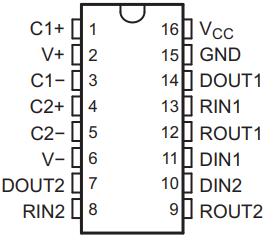
4. Pin Configuration
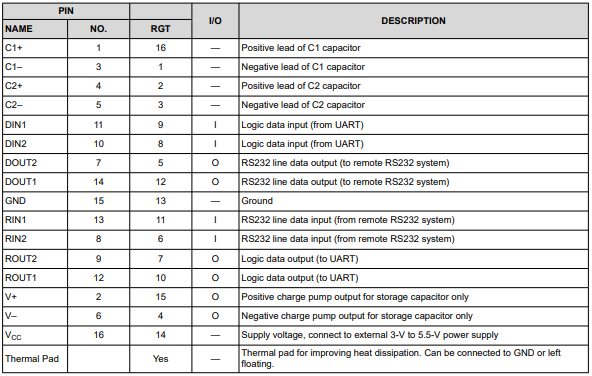
5. Pin Functions
6. Application Information
The TRS3232ECPWR interfaces logic lines from a UART or microcontroller to the voltage and current levels needed for RS232 communication. The TIN inputs will accept 5-V logic with 3.3-V VCC supply. All baud rates up to 250-kbps are supported. It is important to use the correct capacitors for the VCC voltage. This will reduce ripple voltage on the TOUT outputs. If only one driver is needed, the unused driver input should be connected to VCC or ground.

