Can ship immediately
Due to market price fluctuations,if you need to purchase or consult the price.You can contact us or emial to us: brenda@hongda-ic.com
1. Describe
INA828IDR is a high precision instrument amplifier that provides low power consumption and Operates on a very wide single or dual supply scope. A single external resistor sets any gain to 1 to 1000. The device provides excellent accuracy due to Using the new ultra-beta input transistors, Provides very low input offset voltage, offset voltage drift, input bias current and input voltage and current noise. Additional circuit protection input Resistant to overvoltages up to ±40 V. The INA828 is optimized to provide excellent Common Mode Rejection Ratio. CMRR exceeds 90 dB at G = 1 Enter the common mode range. The device is perfect for Low Voltage Operation for 5V Single Supply and dual power supplies up to ±18 V. Finally, the INA828 is Available in 8-pin SOIC package and specified Over the temperature range of –40°C to +125°C.
2. Feature
1. Evolution of Precision Instrumentation Amplifiers:
– Second generation: INA828
– First generation: INA128
2. Low offset voltage: 50 µV, max
3. Gain drift: 5 ppm/°C (G = 1), 50 ppm/°C (G > 1)
4. Noise: 7 nV/√Hz
5. Bandwidth: 2 MHz (G = 1), 260 kHz (G = 100)
6. Stable 1nF capacitive load
7. Input protected up to ±40 V
8. Common Mode Rejection:
– 110 dB, min (G = 10)
9. Power Supply Rejection: 100 dB, min (G = 1)
10. Supply current: 650 µA, max
11. Scope of supply:
– Single supply: 4.5 V to 36 V
– Dual supply: ±2.25 V to ±18 V
12. Specify the temperature range:
–40°C to +125°C
13. Package: 8-pin SOIC
3. Application
1. Industrial Process Control
2. circuit breakers
3. Battery Tester
4. ECG amplifier
5. Electricity automation
6. Medical equipment
7. Portable instruments
4. Typical application
Three-terminal programmable logic controller (PLC) design for the INA828. This PLC reference design accepts ±10 V or ±20 mA input. The output is a single-ended voltage of 2.5 V ±2.3 V (or 200mV to 4.8V). Many PLCs typically have these input and output ranges.
5. Pin configuration
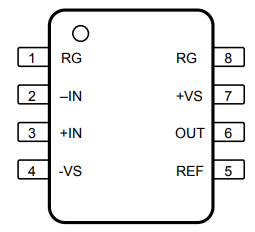
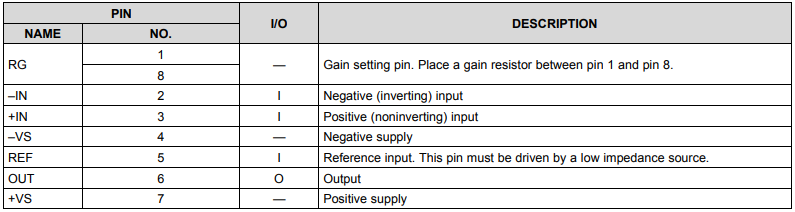
6. Pin Description