
Can ship immediately
Due to market price fluctuations,if you need to purchase or consult the price.You can contact us or emial to us: brenda@hongda-ic.com
1. Description
The LPC4320FBD144,551 are ARM Cortex-M4 based microcontrollers for embedded applications which include an ARM Cortex-M0 coprocessor, up to 264 kB of SRAM, advanced configurable peripherals such as the State Configurable Timer/PWM (SCTimer/PWM) and the Serial General-Purpose I/O (SGPIO) interface, two high-speed USB controllers, Ethernet, LCD, an external memory controller, and multiple digital and analog peripherals. The LPC4320FBD144,551 operate at CPU frequencies of up to 204 MHz. The ARM Cortex-M4 is a 32-bit core that offers system enhancements such as low power consumption, enhanced debug features, and a high level of support block integration. The ARM Cortex-M4 CPU incorporates a 3-stage pipeline, uses a Harvard architecture with separate local instruction and data buses as well as a third bus for peripherals, and includes an internal prefetch unit that supports speculative branching. The ARM Cortex-M4 supports single-cycle digital signal processing and SIMD instructions. A hardware floating-point processor is integrated in the core. The ARM Cortex-M0 coprocessor is an energy-efficient and easy-to-use 32-bit core which is code- and tool-compatible with the Cortex-M4 core. The Cortex-M0 coprocessor offers up to 204 MHz performance with a simple instruction set and reduced code size. In LPC43x0, the Cortex-M0 coprocessor hardware multiply is implemented as a 32-cycle iterative multiplier
2. Features
1. Cortex-M4 Processor core
- ARM Cortex-M4 processor, running at frequencies of up to 204 MHz.
- Built-in Memory Protection Unit (MPU) supporting eight regions.
- Built-in Nested Vectored Interrupt Controller (NVIC).
- Hardware floating-point unit.
- Non-maskable Interrupt (NMI) input.
- JTAG and Serial Wire Debug (SWD), serial trace, eight breakpoints, and four watch points.
- Enhanced Trace Module (ETM) and Enhanced Trace Buffer (ETB) support.
- System tick timer.
2. Cortex-M0 Processor core
- ARM Cortex-M0 co-processor capable of off-loading the main ARM Cortex-M4 application processor.
- Running at frequencies of up to 204 MHz.
- JTAG and built-in NVIC.
3. On-chip memory
- Up to 264 kB SRAM for code and data use.
- Multiple SRAM blocks with separate bus access. Two SRAM blocks can be powered down individually.
- 64 kB ROM containing boot code and on-chip software drivers.
- 64 bit + 256 bit general-purpose One-Time Programmable (OTP) memory.
4. Clock generation unit
- Crystal oscillator with an operating range of 1 MHz to 25 MHz.
- 12 MHz Internal RC (IRC) oscillator trimmed to 1.5 % accuracy over temperature and voltage.
- Ultra-low power Real-Time Clock (RTC) crystal oscillator.
- Three PLLs allow CPU operation up to the maximum CPU rate without the need for a high-frequency crystal. The second PLL is dedicated to the High-speed USB, the third PLL can be used as audio PLL.
- Clock output.
5. Configurable digital peripherals
- Serial GPIO (SGPIO) interface.
- State Configurable Timer (SCTimer/PWM) subsystem on AHB.
- Global Input Multiplexer Array (GIMA) allows to cross-connect multiple inputs and outputs to event driven peripherals like the timers, SCTimer/PWM, and ADC0/1.
6. Serial interfaces
- Quad SPI Flash Interface (SPIFI) with 1-, 2-, or 4-bit data at rates of up to 52 MB per second.
- 10/100T Ethernet MAC with RMII and MII interfaces and DMA support for high throughput at low CPU load. Support for IEEE 1588 time stamping/advanced time stamping (IEEE 1588-2008 v2).
- One High-speed USB 2.0 Host/Device/OTG interface with DMA support and on-chip high-speed PHY (USB0).
- One High-speed USB 2.0 Host/Device interface with DMA support, on-chip full-speed PHY and ULPI interface to external high-speed PHY (USB1).
- USB interface electrical test software included in ROM USB stack.
- Four 550 UARTs with DMA support: one UART with full modem interface; one UART with IrDA interface; three USARTs support UART synchronous mode and a smart card interface conforming to ISO7816 specification.
- Up to two C_CAN 2.0B controllers with one channel each. Use of C_CAN controller excludes operation of all other peripherals connected to the same bus bridge.
- Two SSP controllers with FIFO and multi-protocol support. Both SSPs with DMA support.
- One SPI controller.
7. Digital peripherals
- External Memory Controller (EMC) supporting external SRAM, ROM, NOR flash, and SDRAM devices.
- LCD controller with DMA support and a programmable display resolution of up to 1024 H × 768 V. Supports monochrome and color STN panels and TFT color panels; supports 1/2/4/8 bpp Color Look-Up Table (CLUT) and 16/24-bit direct pixel mapping.
- Secure Digital Input Output (SD/MMC) card interface.
- Eight-channel General-Purpose DMA controller can access all memories on the AHB and all DMA-capable AHB slaves.
- Up to 164 General-Purpose Input/Output (GPIO) pins with configurable pull-up/pull-down resistors.
- GPIO registers are located on the AHB for fast access. GPIO ports have DMA support.
- Up to eight GPIO pins can be selected fom all GPIO pins as edge and level sensitive interrupt sources.
- Two GPIO group interrupt modules enable an interrupt based on a programmable pattern of input states of a group of GPIO pins.
- Four general-purpose timer/counters with capture and match capabilities.
- One motor control Pulse Width Modulator (PWM) for three-phase motor control.
- One Quadrature Encoder Interface (QEI).
- Repetitive Interrupt timer (RI timer).
- Windowed watchdog timer (WWDT).
- Ultra-low power Real-Time Clock (RTC) on separate power domain with 256 bytes of battery powered backup registers.
- Alarm timer; can be battery powered.
8. Analog peripherals
- One 10-bit DAC with DMA support and a data conversion rate of 400 kSamples/s.
- Two 10-bit ADCs with DMA support and a data conversion rate of 400 kSamples/s. Up to eight input channels per ADC.
9. Unique ID for each device.
10. Power
- Single 3.3 V (2.2 V to 3.6 V) power supply with on-chip internal voltage regulator for the core supply and the RTC power domain.
- RTC power domain can be powered separately by a 3 V battery supply.
- Four reduced power modes: Sleep, Deep-sleep, Power-down, and Deep power-down.
- Processor wake-up from Sleep mode via wake-up interrupts from various peripherals.
- Wake-up from Deep-sleep, Power-down, and Deep power-down modes via external interrupts and interrupts generated by battery powered blocks in the RTC power domain.
- Brownout detect with four separate thresholds for interrupt and forced reset.
- Power-On Reset (POR).
- Available as LBGA256, TFBGA180, and TFBGA100 packages and as LQFP144 package.
3. Applications
1. Motor control
2. Embedded audio applications
3. Power management
4. Industrial automation
5. White goods
6. e-metering
7. RFID readers
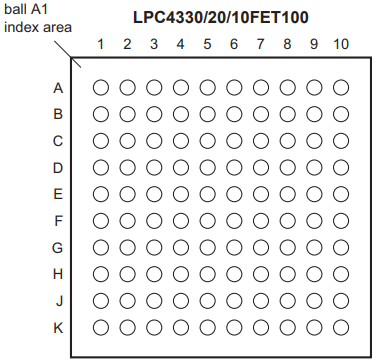
4. Pin configuration
5. Pin Description
On the LPC4320FBD144,551, the digital pins are divided into 16 ports, named P0 to P9 and PA to PF, with a maximum of 20 pins per port. Each digital pin supports up to eight different digital functions, including general purpose I/O (GPIO), selectable by the system Configuration Unit (SCU) registers. A pin name does not indicate which GPIO port is assigned to it. These parts contain two 10-bit ADCs (ADC0 and ADC1). The input channels of ADC0 and ADC1 on dedicated pins and multiplexed pins are combined in such a way that all channel 0 inputs (named ADC0_0 and ADC1_0) are connected together and connected to both channels 0 on ADC0 and channel 0 on ADC1, the channel 1 inputs (named ADC0_1 and ADC1_1) are wired together and connected to channel 1 on ADC0 and ADC1, and so on. There are two ADCs for a total of 8 ADC channels.

