
Can ship immediately
Due to market price fluctuations,if you need to purchase or consult the price.You can contact us or emial to us: brenda@hongda-ic.com
1. DESCRIPTION
The Texas Instruments MSP430™ family of ultra-low power microcontrollers consists of several devices featuring different sets of peripherals targeted for various applications. The architecture, combined with five low-power modes, is optimized to achieve extended battery life in portable measurement applications. The device features a powerful 16-bit RISC CPU, 16-bit registers, and constant generators that contribute to maximum code efficiency. The calibrated digitally controlled oscillator (DCO) allows wake-up from low-power modes to active mode in less than 1 µs. The MSP430F23x, MSP430F247TPMR, and MSP430F2410 series are microcontroller configurations with two builtin 16-bit timers, a fast 12-bit A/D converter (not MSP430F24x1), a comparator, four (two in MSP430F23x) universal serial communication interface (USCI) modules, and up to 48 I/O pins. The MSP430F24x1 devices are identical to the MSP430F24x devices, with the exception that the ADC12 module is not implemented. The MSP430F23x devices are identical to the MSP430F24x devices, with the exception that a reduced Timer_B, one USCI module, and less RAM are integrated.
2. FEATURES
1. Low Supply-Voltage Range, 1.8 V to 3.6 V
2. Ultra-Low Power Consumption
– Active Mode: 270 µA at 1 MHz, 2.2 V
– Standby Mode (VLO): 0.3 µA
– Off Mode (RAM Retention): 0.1 µA
3. Ultra-Fast Wake-Up From Standby Mode in Less Than 1 µs
4. 16-Bit RISC Architecture, 62.5-ns Instruction Cycle Time
5. Basic Clock Module Configurations:
– Internal Frequencies up to 16 MHz
– Internal Very Low-Power LF Oscillator
– 32-kHz Crystal
– Internal Frequencies up to 16 MHz With Four Calibrated Frequencies to ±1%
– Resonator
– External Digital Clock Source
– External Resistor
6. 12-Bit Analog-to-Digital (A/D) Converter With Internal Reference, Sample-and-Hold, and Autoscan Feature
7. 16-Bit Timer_A With Three Capture/Compare Registers
8. 16-Bit Timer_B With Seven Capture/Compare With Shadow Registers
9. Four Universal Serial Communication Interfaces (USCI)
– USCI_A0 and USCI_A1
– Enhanced UART Supporting Auto-Baudrate Detection
– IrDA Encoder and Decoder
– Synchronous SPI
– USCI_B0 and USCI_B1
– I2C™
– Synchronous SPI
10. On-Chip Comparator
11. Supply Voltage Supervisor/Monitor With Programmable Level Detection
12. Brownout Detector
13. Bootstrap Loader
14. Serial Onboard Programming, No External Programming Voltage Needed, Programmable Code Protection by Security Fuse
15. Family Members Include:
– MSP430F233
8KB+256B Flash Memory
1KB RAM
– MSP430F235
16KB+256B Flash Memory
2KB RAM
– MSP430F247, MSP430F2471
32KB+256B Flash Memory
4KB RAM
– MSP430F248, MSP430F2481
48KB+256B Flash Memory
4KB RAM
– MSP430F249, MSP430F2491
60KB+256B Flash Memory
2KB RAM
– MSP430F2410
56KB+256B Flash Memory
4KB RAM
16. Available in 64-Pin QFP and 64-Pin QFN Packages
3. Pin configuration
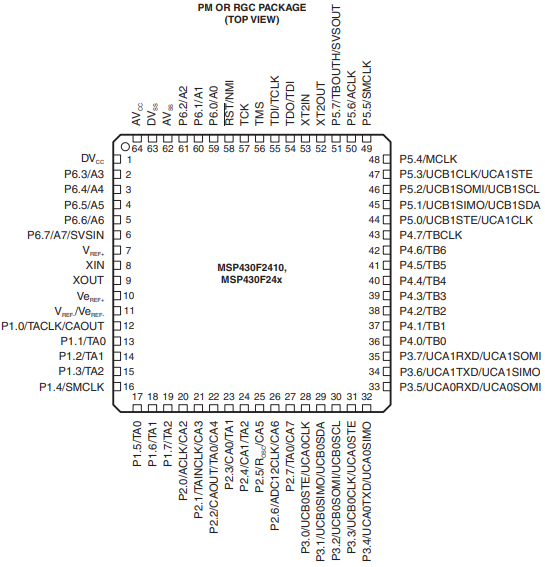
4. Operating Modes
The MSP430 has one active mode and five software-selectable low-power modes of operation. An interrupt event can wake up the device from any of the five low-power modes, service the request, and restore back to the low-power mode on return from the interrupt program. The following six operating modes can be configured by software:
1. Active mode (AM)
– All clocks are active.
2. Low-power mode 0 (LPM0)
– CPU is disabled.
– ACLK and SMCLK remain active. MCLK is disabled.
3. Low-power mode 1 (LPM1)
– CPU is disabled ACLK and SMCLK remain active. MCLK is disabled.
– DCO dc-generator is disabled if DCO not used in active mode.
4. Low-power mode 2 (LPM2)
– CPU is disabled.
– MCLK and SMCLK are disabled.
– DCO dc-generator remains enabled.
– ACLK remains active.
5. Low-power mode 3 (LPM3)
– CPU is disabled.
– MCLK and SMCLK are disabled.
– DCO dc-generator is disabled.
– ACLK remains active.
6. Low-power mode 4 (LPM4)
– CPU is disabled.
– ACLK is disabled.
– MCLK and SMCLK are disabled.
– DCO dc-generator is disabled.
– Crystal oscillator is stopped.
5. CPU
The MSP430F247TPMR CPU has a 16-bit RISC architecture that is highly transparent to the application. All operations, other than program-flow instructions, are performed as register operations in conjunction with seven addressing modes for source operand and four addressing modes for destination operand. The CPU is integrated with 16 registers that provide reduced instruction execution time. The register-toregister operation execution time is one cycle of the CPU clock. Four of the registers, R0 to R3, are dedicated as program counter, stack pointer, status register, and constant generator, respectively. The remaining registers are general-purpose registers. Peripherals are connected to the CPU using data, address, and control buses, and can be handled with all instructions.
6. Development tool support
All MSP430 microcontrollers include an Embedded Emulation Module (EEM), allowing advanced debugging and Programming through easy-to-use development tools. The recommended hardware options include:
1. Debug and programming interface
– MSP-FET430UIF (USB)
– MSP-FET430PIF (parallel port)
2. Debug and programming interface with target board
– MSP-FET430U64 (PM package)
3. Independent target board
– MSP-TS430PM64 (PM package)
4. Production programmer
– MSP-GANG430

