Can ship immediately
Due to market price fluctuations,if you need to purchase or consult the price.You can contact us or emial to us: brenda@hongda-ic.com
1. Features
1. 5-stage pipeline
2. 32-bit address and data paths
3. MIPS32 Enhanced Architecture (Release 2)
- Multiply-accumulate and multiply-subtract instructions
- Targeted multiply instruction
- Zero/One detect instructions
- WAIT instruction
- Conditional move instructions (MOVN, MOVZ)
- Vectored interrupts
- Programmable exception vector base
- Atomic interrupt enable/disable
- GPR shadow registers to minimize latency for interrupt handlers
- Bit field manipulation instructions
4. MIPS16e® code compression
- 16-bit encoding of 32-bit instructions to improve code density
- Special PC-relative instructions for efficient loading of addresses and constants
- SAVE and RESTORE macro instructions for setting up and tearing down stack frames within subroutines
- Improved support for handling 8-bit and 16-bit data types
5. Simple Fixed Mapping Translation (FMT) mechanism
6. Simple dual bus interface
- Independent 32-bit address and data busses
- Transactions can be aborted to improve interrupt latency
7. Autonomous multiply/divide unit
- Maximum issue rate of one 32x16 multiply per clock
- Maximum issue rate of one 32x32 multiply every other clock
- Early-in iterative divide. Minimum 11 and maximum 33 clock latency (dividend (rs) sign extension-dependent)
8. Power control
- Minimum frequency: 0 MHz
- Low-Power mode (triggered by WAIT instruction)
- Extensive use of local gated clocks
9. EJTAG debug and instruction trace
- Support for single stepping
- Virtual instruction and data address/value
- Breakpoints
- PC tracing with trace compression
2. Operating Conditions
- 2.3V to 3.6V, -40ºC to +105ºC, DC to 80 MHz
3. Core: 80 MHz/105 DMIPS MIPS32® M4K®
1. MIPS16e® mode for up to 40% smaller code size
2. Code-efficient (C and Assembly) architecture
3. Single-cycle (MAC) 32x16 and two-cycle 32x32 multiply
4. Clock Management
1. 0.9% internal oscillator (on some variants)
2. Programmable PLLs and oscillator clock sources
3. Fail-Safe Clock Monitor (FSCM)
4. Independent Watchdog Timer
5. Fast wake-up and start-up
5. Power Management
1. Low-power management modes (Sleep and Idle)
2. Integrated Power-on Reset, Brown-out Reset
3. 0.5 mA/MHz dynamic current (typical)
4. 41 µA IPD current (typical)
6. Graphics Features
1. External graphics interface with up to 34 Parallel Master Port (PMP) pins:
- Interface to external graphics controller
- Capable of driving LCD directly with DMA and internal or external memory
7. Analog Features
1. ADC Module:
- 10-bit 1 Msps rate with one Sample and Hold (S&H)
- 16 analog inputs
- Can operate during Sleep mode
2. Flexible and independent ADC trigger sources
3. Comparators:
- Two dual-input Comparator modules
- Programmable references with 32 voltage points
8. Timers/Output Compare/Input Capture
1. Five General Purpose Timers:
- Five 16-bit and up to two 32-bit Timers/Counters
2. Five Output Compare (OC) modules
3. Five Input Capture (IC) modules
4. Real-Time Clock and Calendar (RTCC) module
9. Communication Interfaces
1. USB 2.0-compliant Full-Speed OTG controller
2. 10/100 Mbps Ethernet MAC with MII and RMII interface
3. CAN module:
- 2.0B Active with DeviceNet™ addressing support
4. Six UART modules (20 Mbps):
- Supports LIN 2.1 protocols and IrDA® support
5. Up to four 4-wire SPI modules (25 Mbps)
6. Up to five I2C modules (up to 1 Mbaud) with SMBus support
7. Parallel Master Port (PMP)
10. Direct Memory Access (DMA)
1. Up to eight channels of hardware DMA with automatic data size detection
2. 32-bit Programmable Cyclic Redundancy Check (CRC)
3. Six additional channels dedicated to USB, Ethernet and CAN modules
11. Input/Output
1. 15 mA or 10 mA source/sink for standard VOH/VOL and up to 22 mA for non-standard VOH1
2. 5V-tolerant pins
3. Selectable open drain and pull-ups
4. External interrupts
12. Qualification and Class B Support
1. AEC-Q100 REVH (Grade 2 -40ºC to +105ºC)
2. Class B Safety Library, IEC 60730
13. Debugger Development Support
1. In-circuit and in-application programming
2. 4-wire MIPS® Enhanced JTAG interface
3. Unlimited program and six complex data breakpoints
4. IEEE 1149.2-compatible (JTAG) boundary scan
14. USB AND CAN FEATURES
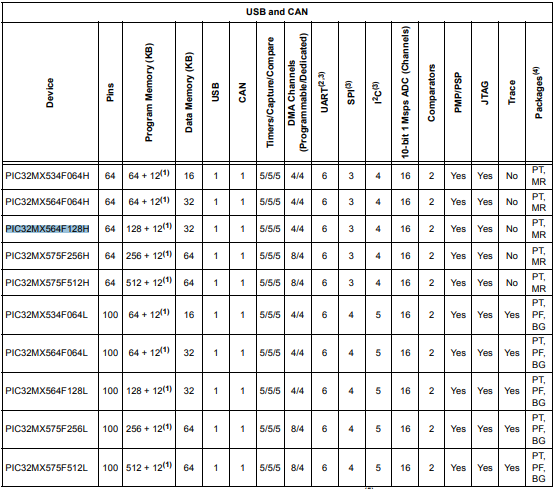
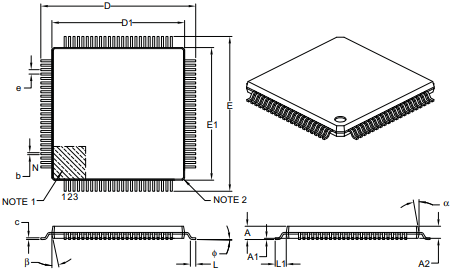
15. Package overview