
Can ship immediately
Due to market price fluctuations,if you need to purchase or consult the price.You can contact us or emial to us: brenda@hongda-ic.com
1. Description
The STM32F051C8T6 microcontrollers incorporate the high-performance ARM® Cortex®-M0 32-bit RISC core operating at up to 48 MHz frequency, high-speed embedded memories (up to 64 Kbytes of Flash memory and 8 Kbytes of SRAM), and an extensive range of enhanced peripherals and I/Os. All devices offer standard communication interfaces (up to two I2Cs, up to two SPIs, one I2S, one HDMI CEC and up to two USARTs), one 12-bit ADC, one 12-bit DAC, six 16-bit timers, one 32-bit timer and an advanced-control PWM timer. The STM32F051xx microcontrollers operate in the -40 to +85 °C and -40 to +105 °C temperature ranges, from a 2.0 to 3.6 V power supply. A comprehensive set of powersaving modes allows the design of low-power applications. The STM32F051xx microcontrollers include devices in seven different packages ranging from 32 pins to 64 pins with a die form also available upon request. Depending on the device chosen, different sets of peripherals are included. These features make the STM32F051xx microcontrollers suitable for a wide range of applications such as application control and user interfaces, hand-held equipment, A/V receivers and digital TV, PC peripherals, gaming and GPS platforms, industrial applications, PLCs, inverters, printers, scanners, alarm systems, video intercoms and HVACs.
2. Features
1. Core: ARM® 32-bit Cortex®-M0 CPU, frequency up to 48 MHz
2. Memories
– 16 to 64 Kbytes of Flash memory
– 8 Kbytes of SRAM with HW parity checking
3. CRC calculation unit
4. Reset and power management
– Digital and I/O supply: VDD = 2.0 V to 3.6 V
– Analog supply: VDDA = from VDD to 3.6 V
– Power-on/Power down reset (POR/PDR)
– Programmable voltage detector (PVD)
– Low power modes: Sleep, Stop, Standby
– VBAT supply for RTC and backup registers
5. Clock management
– 4 to 32 MHz crystal oscillator
– 32 kHz oscillator for RTC with calibration
– Internal 8 MHz RC with x6 PLL option
– Internal 40 kHz RC oscillator
6. Up to 55 fast I/Os
– All mappable on external interrupt vectors
– Up to 36 I/Os with 5 V tolerant capability
7. 5-channel DMA controller
8. One 12-bit, 1.0 µs ADC (up to 16 channels)
– Conversion range: 0 to 3.6 V
– Separate analog supply from 2.4 up to 3.6
9. One 12-bit DAC channel
10. Two fast low-power analog comparators with programmable input and output
11. Up to 18 capacitive sensing channels supporting touchkey, linear and rotary touch sensors
12. Up to 11 timers
– One 16-bit 7-channel advanced-control timer for 6 channels PWM output, with deadtime generation and emergency stop
– One 32-bit and one 16-bit timer, with up to 4 IC/OC, usable for IR control decoding
– One 16-bit timer, with 2 IC/OC, 1 OCN, deadtime generation and emergency stop
– Two 16-bit timers, each with IC/OC and OCN, deadtime generation, emergency stop and modulator gate for IR control
– One 16-bit timer with 1 IC/OC
– Independent and system watchdog timers
– SysTick timer: 24-bit downcounter
– One 16-bit basic timer to drive the DAC
13. Calendar RTC with alarm and periodic wakeup from Stop/Standby
14. Communication interfaces
– Up to two I2C interfaces, one supporting Fast Mode Plus (1 Mbit/s) with 20 mA current sink, SMBus/PMBus and wakeup from Stop mode
– Up to two USARTs supporting master synchronous SPI and modem control, one with ISO7816 interface, LIN, IrDA capability, auto baud rate detection and wakeup feature
– Up to two SPIs (18 Mbit/s) with 4 to 16 programmable bit frame, one with I2S interface multiplexed
15. HDMI CEC interface, wakeup on header reception
16. Serial wire debug (SWD)
17. 96-bit unique ID
18. All packages ECOPACK®2
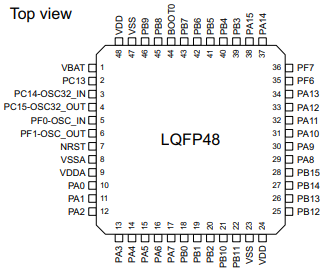
3. Pin configuration
4. Low-power modes
The STM32F051xx microcontrollers support three low-power modes to achieve the best compromise between low power consumption, short startup time and available wakeup sources:
1. Sleep mode
In Sleep mode, only the CPU is stopped. All peripherals continue to operate and can wake up the CPU when an interrupt/event occurs.
2. Stop mode
Stop mode achieves very low power consumption while retaining the content of SRAM and registers. All clocks in the 1.8 V domain are stopped, the PLL, the HSI RC and the HSE crystal oscillators are disabled. The voltage regulator can also be put either in normal or in low power mode. The device can be woken up from Stop mode by any of the EXTI lines. The EXTI line source can be one of the 16 external lines, the PVD output, RTC, I2C1, USART1,COMPx or the CEC. The CEC, USART1 and I2C1 peripherals can be configured to enable the HSI RC oscillator so as to get clock for processing incoming data. If this is used when the voltage regulator is put in low power mode, the regulator is first switched to normal mode before the clock is provided to the given peripheral.
3. Standby mode
The Standby mode is used to achieve the lowest power consumption. The internal voltage regulator is switched off so that the entire 1.8 V domain is powered off. The PLL, the HSI RC and the HSE crystal oscillators are also switched off. After entering Standby mode, SRAM and register contents are lost except for registers in the RTC domain and Standby circuitry. The device exits Standby mode when an external reset (NRST pin), an IWDG reset, a rising edge on the WKUP pins, or an RTC event occurs.

