
Can ship immediately
Due to market price fluctuations,if you need to purchase or consult the price.You can contact us or emial to us: brenda@hongda-ic.com
1. Describe
Microchip Technology's MCP2515-I/ST is a standalone Controller Area Network (CAN) controller, implementing the CAN specification, version 2.0B. it has the ability Send and receive standard and Extended data and remote frames. The MCP2515 has two acceptance masks and six acceptance filters, used to filter out unwanted messages, thus Reduce the overhead of the host MCU. MCP2515 Interface to Microcontrollers (MCUs) by Industry Standard Serial Peripheral Interface (SPI).
2. Feature
1. CAN V2.0B at 1 Mb/s:
- 0 to 8 bytes in length in the data field
- Standard and Extended Data and Remote frame
2. Receive buffers, masks and filters:
- Two receive buffers with priority messages storage
- Six 29-bit filters
- Two 29-bit masks
3. Data byte filtering for the first two data bytes (for standard dataframes)
4. Three prioritized transmit buffers and Abort function
5. High-speed SPI interface (10 MHz):
- SPI mode 0,0 and 1,1
6. One-Shot mode ensures message delivery try only once
7. Clock output pins with programmable prescaler:
- Can be used as other clock source equipment
8. Start of Frame (SOF) signal can be used for To monitor SOF signals:
- Available for slot based protocols and/or bus diagnostics to detect early bus degradation
9. Interrupt output pin with selectable enable
10. Buffer full output pins can be configured as:
- Interrupt output for each receive buffer
- Universal output
11. Separate request to send (RTS) input pin Configurable to:
- Control pins request to transmit each send buffer
- Universal input
12. Low power CMOS technology:
- Operating voltage is 2.7V-5.5V
- 5 mA active current (typ.)
- 1 µA standby current (typ) (sleep mode)
13. Supported temperature ranges:
- Industrial (I): -40°C to +85°C
- Extended (E): -40°C to +125°C
14. AEC-Q100 qualified
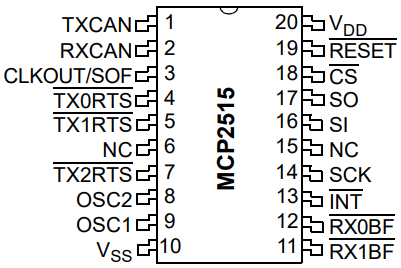
3. Pin configuration
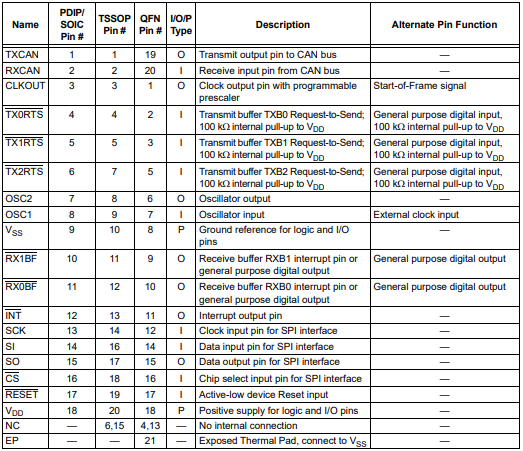
4. Pin Description
5. CAN module
The CAN module handles all functions for receiving and sending messages on the CAN bus. Messages are transmitted by first loading the appropriate message buffers and control registers. The transfer is initiated via the SPI interface using the control register bits or using the transmit enable pin. Status and errors can be checked by reading the corresponding registers. Any message detected on the CAN bus is checked for errors and then matched against a user-defined filter to see if it should be moved to one of the two receive buffers.
6. Control logic
The control logic block controls the setup and operation of the MCP2515 by interfacing with other blocks to pass information and control. Interrupt pins are provided to allow greater system flexibility. Each receive register has a multipurpose interrupt pin (as well as specific interrupt pins) that can be used to indicate that a valid message has been received and loaded into one of the receive buffers. The use of specific interrupt pins is optional. A general purpose interrupt pin and status register (accessed via the SPI interface) can also be used to determine when a valid message has been received. In addition, there are three pins that can be used to initiate the immediate transmission of a message that has been loaded into one of the three transmit registers. The use of these pins is optional, as initiating message transfers can also be accomplished by utilizing the control registers accessed through the SPI interface.

